# Steep Driveway Design and Access
> How to design a driveway that works on a steep block — gradient limits, surface choices, switchback layouts, drainage channels and council requirements.
URL: https://davidclaudelandscape.locuspilot.com/guide/steep-driveway-design-and-access/
Last-Modified: 2026-05-07
We see sloping blocks as both a beautiful feature and a massive logistical headache for homeowners across Melbourne's eastern suburbs.
Many assume a steep driveway design is just a standard concrete pour laid on an angle. The reality is that poor planning leads to scraped undercarriages, dangerous reversing, and major water runoff issues.
Our team is going to break down the exact gradient limits, surface choices, and design strategies required for compliant access. This guide will walk you through the structural requirements and show you how to master the terrain.
## Why Steep Driveways Need Specialist Design
We witness driveways on steep blocks fail in three very predictable ways. Vehicles bottom out when the slope exceeds the safe gradient outlined in the Australian Standard AS 2890.1.
A steep ramp causes the car's break-over point to hit the pavement, which damages the undercarriage and makes reversing highly dangerous.
Our site assessments frequently uncover uncontrolled surface water as another major problem. Rapid runoff erodes the surface material and turns the slope into a slippery hazard during wet winter months. Poorly specified paving also degrades prematurely under heavy traffic.
Providing safe sloping block driveway access requires a highly specific engineering solution. Gradient problems are solved using switchbacks, calculated grade breaks, and extended driveway runs to lower the incline angle.
Our landscape architects guarantee long-term durability by matching the paving material directly to the steepness of the gradient and the site's specific soil profile. Heavy surface water requires a network of slotted drainage channels, strict cross-falls, and strategically placed catch pits.
## Council Gradient Standards
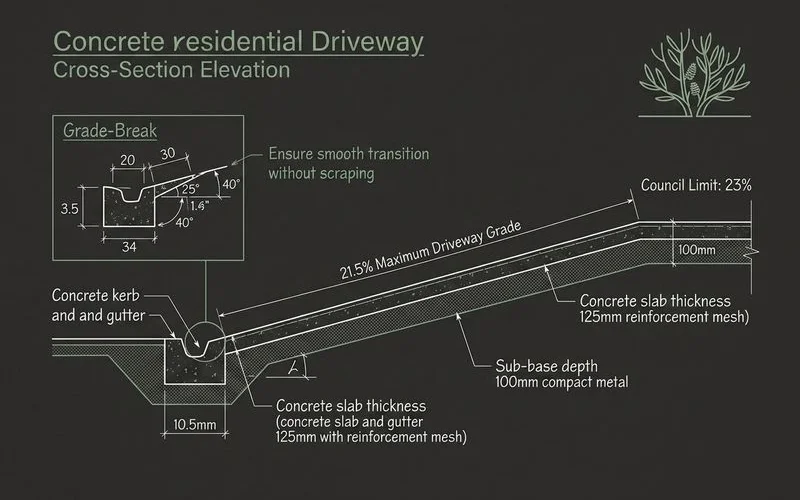
We always start the design process by cross-referencing your site with local council regulations and national standards. The Australian Standard AS 2890.1 caps the absolute maximum gradient for a straight residential driveway at 25 percent, or a 1 in 4 slope.
Pushing a driveway to this extreme limit requires intense precision. Our designers prefer to keep the gradient closer to 20 percent to ensure a comfortable, stress-free climb for daily driving.
Transition zones are legally required to prevent your car from scraping the footpath. The first 6 metres inside your property boundary usually cannot exceed a 5 percent grade to maintain safe sightlines for pedestrians.
You will also need 2-metre transition segments at a 12.5 percent grade anywhere the slope changes significantly. We regularly handle these exact geometrical requirements across Melbourne's eastern municipalities.
Councils like Banyule, Nillumbik, and Manningham stringently enforce these rules. Adhering to their specific Development Control Plans requires understanding a few key local mandates:
* **Maximum Limits:** Most enforce the strict 25 percent AS 2890.1 cap for private access.
* **Transition Zones:** A 5 percent maximum grade is required for the first 6 metres from the boundary.
* **Visual Impact:** Nillumbik Shire Council prefers curved alignments to avoid long straight scars on rising land.
* **Engineering Reports:** Any deviation requires a certified swept path assessment from a traffic engineer.
You must secure a planning permit if your site demands a slope steeper than these baseline standards. Our team has successfully managed this complex approval process for dozens of challenging properties.
## Switchback Design
We rely on a switchback driveway layout when a property is simply too steep for a straight concrete run. A switchback uses one or more sharp turns to travel diagonally across the hillside, effectively halving the steepness of the climb.
This method transforms an impassable slope into a fully compliant access route. Our engineers carefully map these diagonals to respect both the terrain and the property boundaries.
### Critical Elements of a Switchback
Switchback geometry demands absolute precision to ensure standard passenger cars can handle the turns without reversing. The design must account for four major engineering factors:
* **Turning Radius:** A standard Australian B85 passenger vehicle requires a minimum kerb-to-kerb turning circle of 11.5 metres.
* **Clearance Envelopes:** Adding a 300mm clearance margin on both sides prevents bumpers from scraping the retaining walls.
* **Super-Elevation:** A slight camber on the curve leans the vehicle safely into the turn for stability.
* **Apex Drainage:** Water naturally pools at the inner corner of a switchback, requiring heavy-duty catch pits.
The inner edge of the switchback cuts directly into the hillside and almost always requires structural support. Our landscape plans often incorporate terraced retaining walls to manage this cut face safely. Keeping the batter slopes to a 1 in 8 ratio helps minimise erosion and integrates the massive structure naturally into your garden.
## Surface Choices
Selecting the correct surface material is a major safety decision on a highly sloped block. The Australian Standard AS 4586 uses specific slip resistance ratings to classify paving materials, and you need a P5 or R12 rating for maximum traction.
Our team uses these precise ratings to match the right stone or concrete to your driveway's angle. The steeper the angle, the more grip your tyres need, especially during heavy Melbourne downpours.
| Material | Gradient Range | Slip Rating | Strengths | Trade-offs |
|---|---|---|---|---|
| Exposed aggregate concrete | 0-25% | P5 / R12 | Highly durable, extreme traction, cost-effective | Heavy industrial aesthetic |
| Jetblasted bluestone | 0-25% | P5 / R12 | Premium aesthetic, maximum wet safety | Higher material cost |
| Diamond sawn bluestone | 0-18% | P4 / R11 | Smooth profile, dense structure | Reduced grip on maximum slopes |
| Gravel / Crushed rock | 0-12% | N/A | Soft country look, economical | Prone to migration, needs edging |
We strongly default to materials with a P5 wet pendulum rating or an R12 oil-wet ramp rating for any slope above 18 percent. Jetblasted or flame-finished Harkaway bluestone easily achieves this elite R12 status.
The heavy texture provides phenomenal grip for steep residential work, even though it appears slightly less polished than a lightly honed stone. You get the premium look of natural basalt without compromising on safety.
## Drainage on Steep Driveways
We know that steep driveways shed rainwater at terrifying speeds during a storm. A compliant drainage system combines surface cross-falls with heavy-duty slot drains at the base to catch and redirect this water safely.
Building codes strictly prohibit discharging private stormwater over property boundaries onto the council footpath. Our drainage strategies capture and control this water long before it causes damage.
### Engineering a Water Management System
The most effective approach combines surface shaping with commercial-grade capture points. A compliant setup relies on several integrated components:
* **Cross-Falls:** The pavement is poured with a 1 to 2 percent sideways camber to push water off the main driving path.
* **Slot Drains:** Heavy-duty linear channels, such as ACO drains, are installed at the bottom of the ramp.
* **Heelsafe Grates:** Using grates with 6mm to 10mm slots ensures pedestrian safety while handling massive water volumes.
* **Catch Pits:** Deep pits at the lowest points filter out debris before water enters the underground pipes.
Your system must eventually tie directly into the council stormwater network or a dedicated on-site retention tank. Without this specialised infrastructure, the rapid water flow will quickly wash away surrounding garden beds and degrade the driveway surface.
If you are currently evaluating materials for the entire property, we recommend reviewing our guide on premium paving and driveways for a complete breakdown of options. You should also consult our detailed analysis on steep driveway paving considerations if your block has extreme topographical challenges.
## Conclusion: The Final Word on Steep Driveway Design
Getting a sloping block right requires strict adherence to engineering codes and an eye for landscape aesthetics. You cannot afford to guess the gradients or ignore the local drainage standards.
Proper steep driveway design protects your vehicles, secures your property from water damage, and ensures complete council compliance.
Our team at David Claude Landscape Design is ready to assess your terrain. Contact us today to schedule a site consultation and start planning a safe, beautiful entrance for your home.