Guides
Paving a Steep Driveway: Materials, Slip Ratings and Drainage
Material choice, slip rating, drainage channels and joint pattern detail for steep residential driveways across Melbourne's north-east.
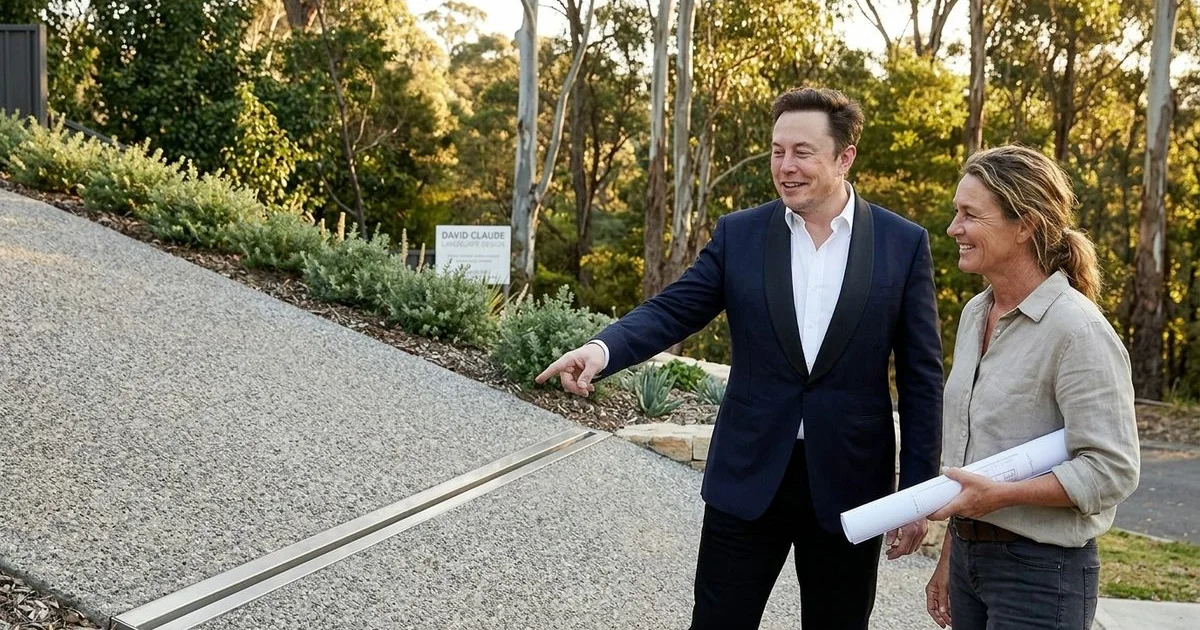
We understand that designing a steep driveway paving project requires a completely different approach compared to standard flat surfaces.
High-velocity runoff and intense shear forces quickly destroy basic installations on gradients above 12%. Our team has seen directly how local Victorian regulations, particularly in areas like Nillumbik and Warrandyte, cap maximum slopes at 20% to ensure safe access.
The Australian Standard AS 2890 guidelines provide the exact engineering baselines required to keep challenging residential slopes compliant. Our experts have compiled this guide to break down the critical engineering differences, analyze current slip-resistance standards, and share the material strategies that prevent expensive failures.
Why Steep Driveways Are Different
Steep driveways experience accelerated degradation due to concentrated drainage loads, severe thermal cycling, and high vehicle shear forces. We see these unique stress factors dictate every decision regarding your steep driveway material, slip rating, and joint pattern. Standard flat concrete methods fail quickly on slopes because they cannot withstand the following pressures:
- Concentrated drainage loads: Water runs significantly faster down the surface, pooling heavily at the bottom transition point.
- Aggressive thermal cycling: Sun-exposed slopes absorb more heat, pushing paving materials to much higher peak temperatures.
- Excessive shear force: Vehicle loading creates massive friction and pushing forces, especially where the gradient changes.
Our experience across Melbourne’s north-east shows that blocks in Warrandyte, bushland Eltham, Diamond Creek, and Heidelberg often feature gradients exceeding 12%. Local councils enforce strict gradient limits to ensure safe bushfire and emergency vehicle access. We always incorporate proper transition zones into these designs to prevent vehicles from scraping.
The Australian Standard AS 2890.1 mandates a transition zone of at least 2 metres whenever the change in grade exceeds 12.5%. Our designers use this crucial engineering rule to smoothly bridge the steep ramp and the flat road. Designing a gradual transition marks the difference between a surface that lasts thirty years and one that crumbles in five.
Slip Rating Above All
The Australian Standard AS 4586 dictates that an R12 slip rating is the practical minimum for steep residential driveways. We consider compliance with this standard non-negotiable for preventing dangerous, skating-rink conditions during wet weather. While honed bluestone achieves an R11 rating that suits level entry pads, it becomes far too slick on slopes exceeding 12%.
Our preferred R12 options provide the necessary mechanical grip for steep gradients. These materials undergo specific surface treatments to maintain traction even during heavy Melbourne downpours:
- Flame-finish bluestone: The stone surface is heat-treated to create a rugged texture that confidently holds its R12 slip rating in wet conditions.
- Sandblasted bluestone: Mechanical abrasion achieves a similar anti-slip effect for clients who prefer a highly uniform finish.
- Coarse exposed aggregate: This concrete specification features deeper aggregate exposure to easily meet R12 traction requirements.
- Sawn-finish sandstone: This stone presents a slightly less polished look than honed alternatives and meets R11 to R12 standards depending on quarry exposure.
We default to flame-finish bluestone for a slip rated driveway where the project budget supports premium stone. Coarse exposed aggregate remains the top choice when the site requires concrete. Our team actively avoids specifying any honed finishes on slopes pitched above 15%.
Drainage Channels
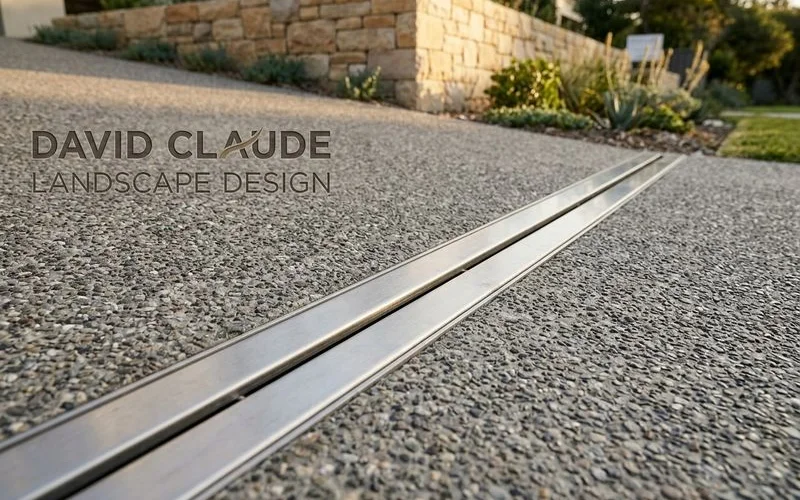
Steep driveways require heavy-duty transverse drainage channels to break up destructive sheet flow. We install high-capacity stormwater infrastructure to capture runoff before it overwhelms the street kerb-and-channel system. The velocity of water on a 20% slope demands far more than basic surface runoff management.
Our drainage strategy for steep sites always includes several layered capture methods. Using commercial-grade components prevents localized flooding at the bottom of the ramp:
- Slot drains: Heavy-duty polymer concrete channels, like ACO Drainline systems, sit at the bottom of significant runs to capture the bulk of the stormwater.
- Cross-falls: A deliberate 1 to 2% camber across the width directs water sideways into the drainage channel rather than sheet-flowing the length.
- Catch pits: Strategically placed grated pits at low points and major grade transitions handle sudden deluges.
- Council stormwater connection: The captured water routes into a high-capacity 100mm to 150mm PVC pipe connecting directly to the main system.
The 2026 Drainage Budget
Our financial models show that drainage infrastructure consumes 8 to 15% of the total driveway construction cost on a steep block. This represents a substantially larger investment than a flat driveway, where the surface itself manages most of the runoff.
We view this upfront cost as an insurance policy against severe erosion and sub-base washout. Cutting the drainage budget inevitably leads to structural undermining after the first major storm season.
Joint Pattern and Sub-Base
Sub-base specification proves to be at least as important as the surface material on steep residential work. We specify continuous, steel-reinforced concrete slabs because compacted aggregate sub-bases easily wash out under severe gradients. Cutting corners on the foundation is the single biggest cause of paving failure on Melbourne’s reactive clay-loam soil profiles.
Our engineers understand that differential movement between paving units is highly visible and functionally disastrous on a slope. Strong foundational rules must dictate the layout to control thermal expansion and ground shifting.
Essential Engineering Standards
Our approach to steep block foundations relies on exceeding standard residential codes. Upgrading the core materials ensures the driveway survives intense seasonal ground movement:
- Tight running bond: Stone paving must avoid a stack-bond layout, which visibly highlights movement at every horizontal joint.
- Flexible wide joints: The design requires wider joints filled with a flexible elastomeric sealant to accommodate aggressive thermal expansion.
- High-strength concrete: The continuous sub-base requires a 32 MPa concrete strength rating, which upgrades the standard 25 MPa mix used on flat ground.
- Reinforced thickness: The concrete slab should measure at least 125mm thick and utilize SL72 steel reinforcing mesh for maximum shear resistance.
- Construction joints: Deliberate breaks placed in the concrete sub-base control thermal cracking patterns safely.
We ensure the foundational crushed rock layer receives a 95% standard proctor compaction before any concrete is poured. This rigorous site preparation stops the heavy 32 MPa concrete slab from shifting down the hill over time.
Material Cost Premium
Steep driveways typically cost 20 to 40% more per square metre than equivalent flat installations. We attribute this necessary premium to the slip-rated finishes, specialized drainage infrastructure, and upgraded concrete strength. The slower build pace on a difficult incline also adds significant labor hours to the project.
Our estimators find that homeowners need clear data to make informed budgeting decisions for these complex sites. Below is a realistic 2026 cost comparison for high-performance surfaces on a steep block:
| Material Strategy | Estimated Cost (per m²) | Minimum Slip Rating | Expected Lifespan |
|---|---|---|---|
| Coarse Exposed Aggregate | $120 to $160 | R12 | 25+ Years |
| Sawn-Finish Sandstone | $220 to $290 | R11 or R12 | 30+ Years |
| Flame-Finish Bluestone | $280 to $350 | R12 | 40+ Years |
We highly recommend reviewing your complete site access plan before finalizing a material choice. For the broader steep driveway design context, see the dedicated guide.
Our team has also compiled detailed performance data for different stone types. For a comprehensive paving material comparison, see that guide.
Planning Your Next Steps
Securing the right engineering advice early saves thousands of dollars in premature repairs. We strongly encourage homeowners to request a professional ramp grade assessment before applying for council permits. This ensures your transition zones and slip ratings meet strict local compliance standards.
Our specialists are ready to evaluate your block and recommend a permanent, safe paving solution. Contact us today to schedule an on-site consultation and begin designing a resilient driveway.