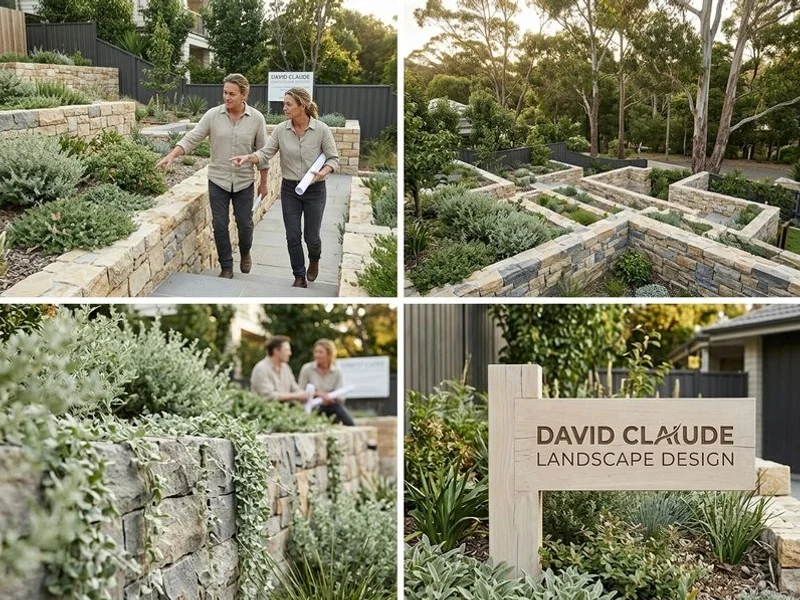
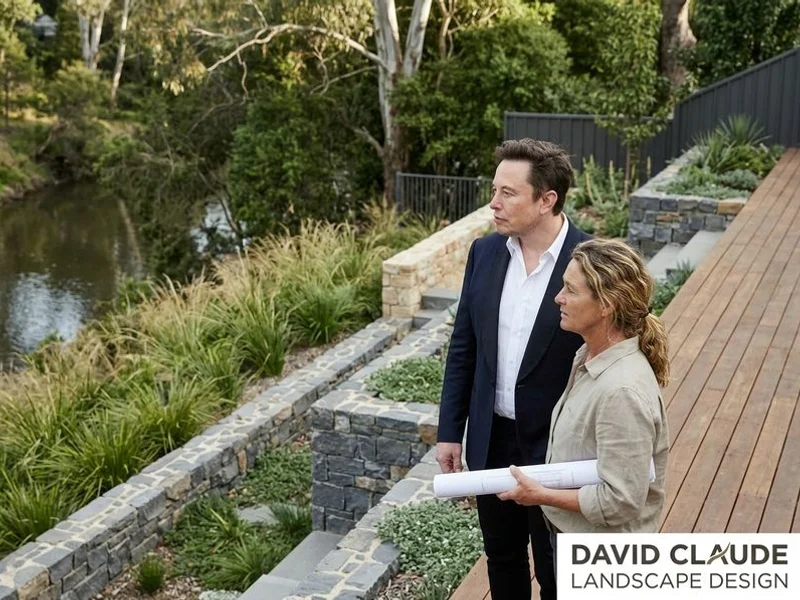
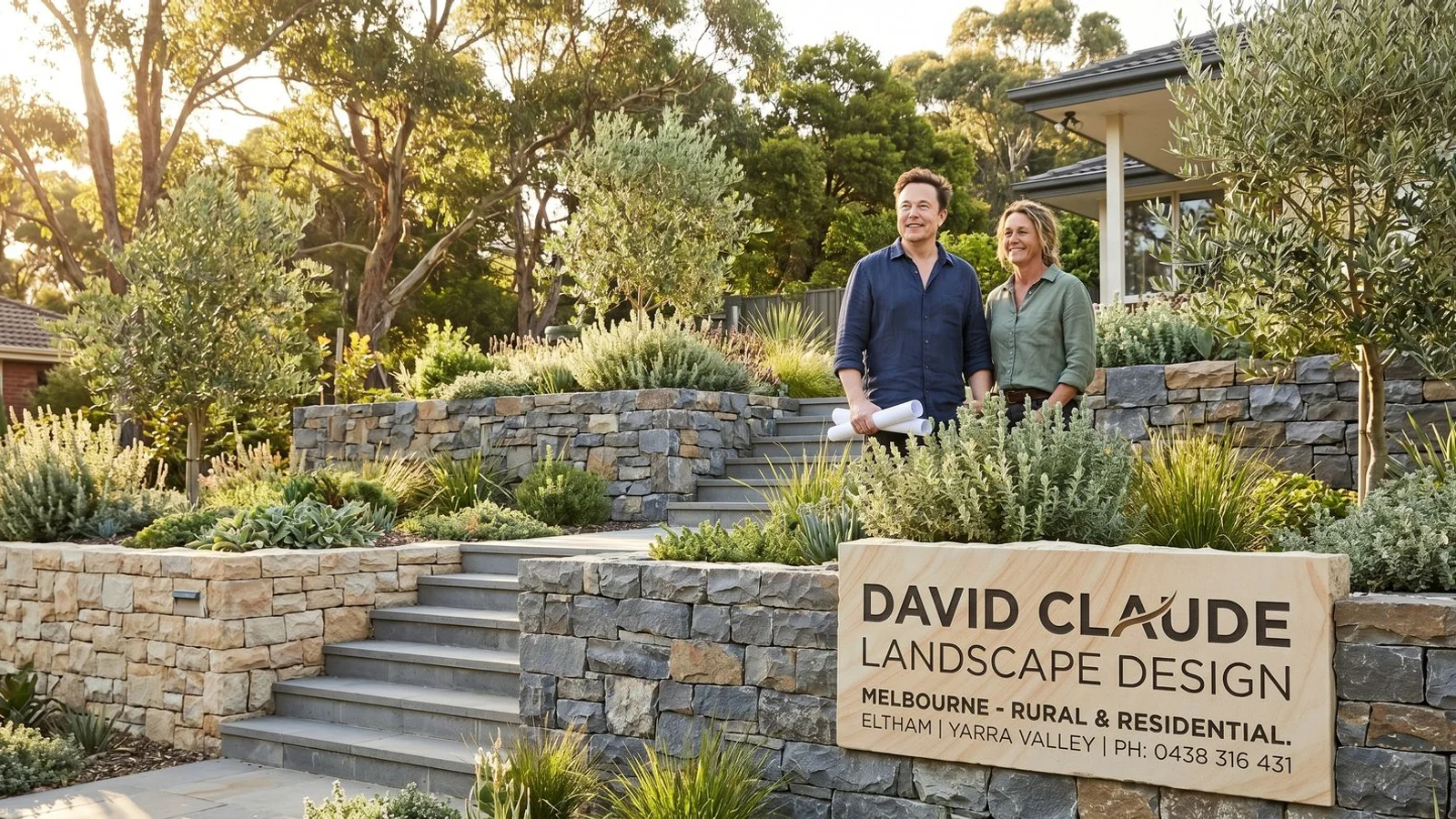
"David and his team transformed our impossibly steep block in Eltham into three terraced garden rooms with bluestone walls and a pool. Engineering, council permits, planting — they handled all of it without losing the design intent."
Sloping Blocks
Steep Block Landscape Design & Construction in Melbourne's North-East
End-to-end design and build for steep, difficult and sloping residential blocks across Melbourne's north-east.
The Challenge
Problems This Service Solves
Generalist Landscapers Walk Away
A steep or sloping block — particularly in Warrandyte, Eltham and Diamond Creek — often ends the conversation with a standard landscaper before it begins. The gradient, the drainage complexity and the council permit requirements sit outside most firms' competence.
Drainage Failures Destroy Retaining
Hydrostatic pressure builds behind any wall where drainage is wrong. The result is tilting, cracking and eventual collapse — sometimes within three to five years. Getting drainage right from the first design decision prevents every downstream failure.
Council Permits and BMO Compliance
Nillumbik's BMO overlay, Banyule's heritage controls and retaining-wall height triggers are non-trivial. A landscaper without permit fluency hands you the problem. We coordinate the engineering, the applications and the certificates.
Design Intent Lost Across Multiple Trades
When you commission a designer, then a separate builder, then a separate permit consultant, the design erodes at every handoff. Our integrated studio — design and build — keeps fidelity intact from first sketch to final stone.
Have you ever stared at your steep backyard and wondered how to make it usable? A severe gradient can feel like an impossible puzzle when the ground just drops away.
We at David Claude Landscape Design specialize in solving these exact puzzles for homeowners across Melbourne. This guide will walk you through the precise steps to turn that tricky incline into a beautiful, functional space.
Grab a cup of coffee, and let’s go through it together.
Our team is here to show you exactly how it works. You will be surprised at how straightforward it can be.
What is Sloping Block Landscaping?
Sloping block landscaping is the integrated design and construction of gardens on steep or graded residential sites. This highly technical work requires specific retaining designs, deep drainage strategies, and real engineering input to do properly. Our team tackles these difficult environments every single day.
Across Melbourne’s north-east, “sloping block” describes most of Warrandyte, much of bushland Eltham, and the acreage country around Diamond Creek. The river-frontage blocks of Heidelberg and Ivanhoe also share these severe drops. Each suburb has its own gradient signature and its own heavy clay-loam soil profile. Generalist landscapers walk away from many of them. We design and build them as a dedicated specialty.
The Engineering Side
The work involves detailed cut and fill engineering to create flat, usable tiers. Tiered retaining systems use heavy materials like bluestone, dry-stack stone, concrete sleepers, and rendered masonry. Our building process relies on a few core elements to ensure stability:
- Deep cut and fill excavations for flat tiers.
- Heavy-duty retaining wall construction.
- Ag-line and surface-water drainage networks.
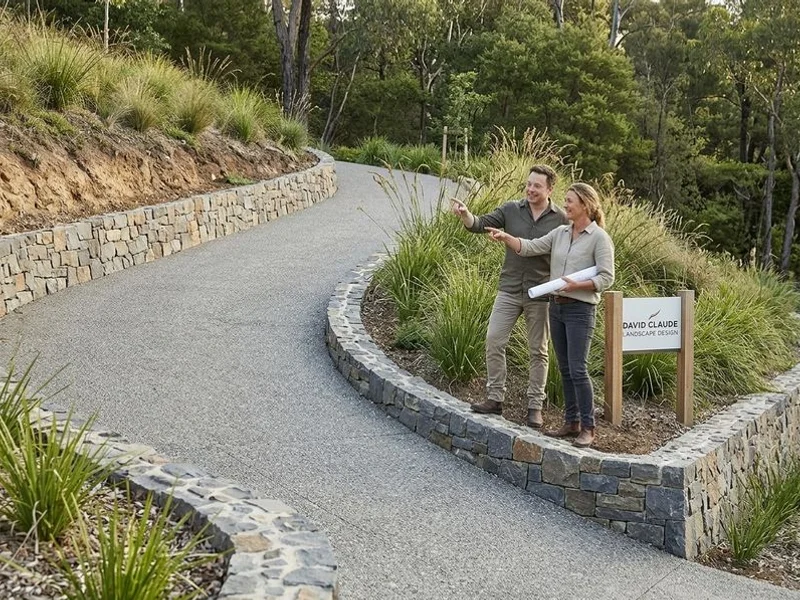
- Switchback driveway designs for safe access.
Choosing the right vegetation is just as important as the structural work. A planting palette must be tuned to indigenous Victorian species that establish faithfully on our local clay soil. We highly recommend using Myoporum parvifolium, commonly known as Creeping Boobialla. This incredibly tough native plant thrives on slopes and quickly forms a dense, weed-suppressing carpet.
Another great option is Correa alba, which handles poor soil and coastal winds with ease. These deep-rooted plants actually help hold the hillside together. Our planting strategies always prioritize long-term soil stability.
Why Steep Blocks Need a Specialist
A flat block forgives simple mistakes. A sloping block absolutely does not. Our experience shows that poor drainage quickly becomes a muddy wet patch in winter. That same wet patch can easily turn into a dangerous slippage event during a heavy summer storm.
The Hidden Dangers of Water
Retaining walls that are underbuilt will almost certainly face a hydrostatic-pressure failure within five years. Trapped water behind a wall gets incredibly heavy and literally pushes the structure over. We always design for worst-case weather scenarios. Driveways that ignore the gradient become terrifyingly unsafe in the rain.
Building to the Australian Standard
The very first step involves reading the contours, the soil profile, and the existing surface water flow. Council permit triggers are checked long before the design conversation gets to planting palettes. Our engineers coordinate all of this early so the design we produce is actually buildable.
Geotechnical testing is required for cut and fill work, while structural engineering is legally required for any retaining wall over 1 metre high. This strict height rule aligns with the Australian Standard AS 4678 for Earth-Retaining Structures.
The 1:3 Rule: For every 1 metre of visible retaining wall above ground, roughly 330mm must be safely embedded below ground to prevent failure.
These precise calculations ensure your investment is safe, legally permitted, and completely durable. You get peace of mind knowing the hill is properly secured. We refuse to compromise on these crucial safety standards.
What We Build
Creating a beautiful, functional space on a hill requires specific materials. Tiered retaining systems are chosen carefully for both the project budget and the architectural pairing with your home. Our material options include bluestone, dry-stack stone, structural concrete sleepers, and rendered masonry.
Comparing Retaining Wall Materials
Different materials offer different lifespans and price points. Concrete sleepers are incredibly popular right now because they will not rot or warp. Bluestone offers a timeless, premium look but requires highly skilled stonemasons to install.
| Material | Lifespan | Aesthetic | Best For |
|---|---|---|---|
| Concrete Sleepers | 50+ Years | Modern, clean lines | Heavy structural loads |
| Solid Bluestone | 100+ Years | Premium, classic | High-end heritage homes |
| Dry-Stack Stone | 75+ Years | Natural, rustic | Bushland integration |
Drainage and Access Solutions
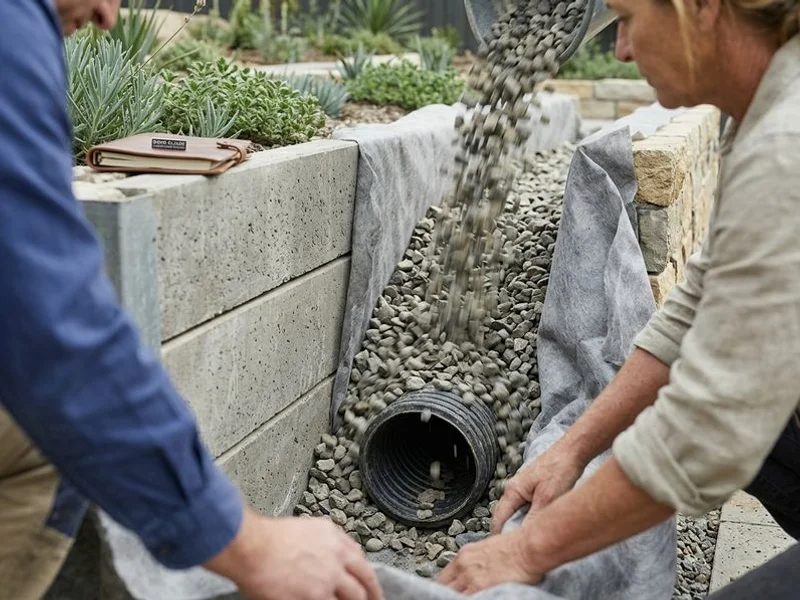
Proper water management happens behind the scenes. Heavy-duty ag-pipe drainage networks sit behind every single wall we construct. We wrap these pipes in geotextile fabric to keep fine clay particles from clogging the system. Surface-water diversion channels then safely control exactly where the slope sheds its runoff.
Switchback driveways provide safe vehicle access on the steepest sites. These curved roads are paired with massive stormwater channels that handle the aggressive gradient. Our paving solutions feature slip-rated finishes and flexible jointing detail that holds up to natural clay-soil heave. These paths and entertaining zones stay flat and safe for decades.
Fire-Safe and Shade-Tolerant Planting
Many local hillsides fall under strict bushfire regulations. Defendable-space planting layouts are mandatory where the Bushfire Management Overlay applies. Our plant selections feature beautiful indigenous Victorian palettes throughout the entire garden.
For those tricky, shaded spots under retaining walls, Dichondra repens (Kidney Weed) is a fantastic native ground cover. It loves the shade and stops erosion on small slopes. Smart irrigation systems are then installed to suit both the severe slope and the dense clay soil. We ensure every plant gets the exact amount of water it needs without washing away the topsoil.
Council Permits Across the North-East
The north-east councils each handle landscape work very differently. Banyule’s strict heritage overlay applies to most properties in Ivanhoe and Heidelberg. Nillumbik’s complex Bushfire Management Overlay applies to almost all of bushland Eltham and Diamond Creek.
Handling Local Regulations
Manningham’s planning context governs areas like Warrandyte and Templestowe. Many of these properties fall under a Significant Landscape Overlay, which tightly protects the local tree canopy. Our administrative team coordinates all these permits as a core part of the project.
Typical council requirements include:
- Significant-tree-register checks.
- Retaining-wall permits over 1 metre.
- Bushfire defendable-space planning.
- Formal tree-removal applications.
In Nillumbik, a formal 10P planning application is often required just to remove native vegetation. This usually requires a detailed report from a qualified arborist. Our project managers strongly advise against cutting corners, as councils issue massive fines for illegal tree removal.
Let’s Discuss Your Project
Sloping block landscaping requires a specific set of skills, but the results are truly spectacular.
A difficult hill can become your favorite part of the property with the right approach.
We would love to hear about your unique site and discuss how to reveal its full potential.
Contact us today to schedule a site consultation and take the first step for your new garden.
What's Included
Scope of Work
- check_circle Geotechnical-aware design and engineering coordination
- check_circle Tiered retaining and terracing using bluestone, stone, concrete sleeper or rendered masonry
- check_circle Sub-surface (ag-line) and surface-water drainage strategies
- check_circle BMO-compliant planting and defendable-space design
- check_circle Steep driveway design, switchbacks and access management
- check_circle Cut and fill engineering coordinated with civil and structural engineers
How We Work
Our Process
Site Read
Paid consultation walks the slope, reads the drainage, identifies retaining and access constraints.
Concept and Engineering
Concept plan paired with engineering input where the slope warrants. Council permit pathway identified up front.
Documentation
Construction drawings, retaining details, drainage plans, planting plans. Submitted for council where required.
Build and Handover
In-house build of retaining, drainage, hardscape and planting. Walkthrough and handover with planting establishment plan.
Why Sloping Blocks
Why Choose Us
Decades of Steep-Block Work
Most of our portfolio is sloping blocks. We've solved the patterns that scare off generalist landscapers.
Drainage, Done Right
Ag-pipe, geotextile, drainage stone and surface water managed correctly behind every wall and across every cut.
Engineering Coordination
Geotechnical and structural engineers are part of the team where the gradient or wall height demands.
Council Permit Fluency
Banyule, Nillumbik and Manningham permit processes are practiced craft, not foreign territory.
30+ Years of North-East Expertise.
Design Fidelity Guaranteed.
Book a Consultation arrow_forward Selected Portfolio
Recent Work
Client Words
Sloping Blocks Testimonials
"We engaged David Claude after another landscaper walked away from our Warrandyte block. The drainage and retaining work was meticulous, and the native planting palette has matured beautifully through three summers."
"From first sketch to final stone placement, we were guided clearly. They built our retaining walls right — drained behind, properly engineered — and we've not had a wet patch through two winters."
Investment
What Sloping Blocks Costs
per project (full design + build)
Project size varies dramatically with block gradient and scope.
Project pricing varies with site complexity, materials and access. We provide a fixed-fee design proposal after a paid consultation, then a fully itemised construction quote.
Book a Consultation arrow_forwardFrequently Asked
Sloping Blocks FAQs
How steep is too steep for a residential landscape?
expand_more
Almost no block is too steep. We've worked sites with 30%+ gradients across Warrandyte and Diamond Creek. The question is what the design has to do — terraced retaining, switchback driveway, ag-line drainage — to make the slope usable and the build durable.
Do you handle the council permits and engineering?
expand_more
Yes. Retaining over 1m, structural landscape work, BMO compliance and tree-removal applications are coordinated by us with Banyule, Nillumbik or Manningham. Geotechnical and structural engineering input is brought in where the gradient warrants.
What materials do you use for retaining on sloping blocks?
expand_more
Bluestone, natural stone, concrete sleeper and rendered masonry are the four most common. Each has its place. Bluestone for premium and heritage; concrete sleeper for budget-sensitive; rendered masonry for a contemporary architectural pairing; dry-stack stone for traditional.
Can you do the design only, without the build?
expand_more
Yes — design-only engagements are available, though most clients use the integrated design + build service so the construction stays faithful to the design intent.
How long does a sloping-block project typically take?
expand_more
Design from consultation to documentation takes 6–12 weeks. Construction varies from 4 months for a single-terrace project to 8+ months for a multi-stage steep estate.
Do BMO bushfire-overlay rules affect the design?
expand_more
Yes — many sloping blocks in Eltham, Warrandyte and bushland Nillumbik fall within the BMO. Defendable-space rings, fire-resistant planting palettes and hardscape buffers become part of the design.
Continue Exploring
Related Services
Retaining Walls
Engineered retaining walls in bluestone, natural stone, concrete sleeper and rendered masonry.
View Service arrow_right_altPaving & Driveways
Premium paving and driveway construction in bluestone, sandstone, exposed aggregate and gravel.
View Service arrow_right_altPool Landscaping & Surrounds
Premium pool surrounds, coping, fencing and integrated poolside gardens — including pools on steep blocks.
View Service arrow_right_altRead Deeper
Sloping Blocks Guides
Detailed answers to the questions clients actually ask about sloping blocks.
Is My Block Too Steep to Landscape?
How to read your block's gradient, what counts as 'too steep' for residential landscape work, and the design strategies that turn even 30%+ slopes into usable gardens.
Read Guide arrow_right_altSloping Block Drainage and Erosion Control
How ag-line networks, geotextile and surface-water management prevent the failures that take out under-drained sloping blocks in Melbourne's clay-loam profile.
Read Guide arrow_right_altSloping Blocks and Bushfire (BMO) Compliance
What the Bushfire Management Overlay means for landscape design on sloping blocks in Eltham, Warrandyte, Diamond Creek and bushland Nillumbik — defendable space, planting and hardscape rules.
Read Guide arrow_right_altSteep Driveway Design and Access
How to design a driveway that works on a steep block — gradient limits, surface choices, switchback layouts, drainage channels and council requirements.
Read Guide arrow_right_altThe Sloping Block Design and Build Process
What to expect at each stage of a steep-block residential landscape project — consultation, engineering, council permits, retaining build and planting establishment.
Read Guide arrow_right_altWhat is Sloping Block Landscaping?
A working definition: sloping block landscaping is integrated design and construction on steep residential sites, including retaining, drainage, terracing and engineered hardscape.
Read Guide arrow_right_altDeck vs Paved Patio on a Sloping Block
How slope, budget, drainage and architectural pairing decide between a timber deck and a paved patio for the entertaining zone of a steep residential block.
Read Guide arrow_right_altRetaining Walls vs Terraced Gardens
When does a single tall retaining wall work better than tiered terracing — and when does terracing produce a better result for the same gradient and budget?
Read Guide arrow_right_altSloping Block Landscaping Cost in Victoria
Realistic project bands for sloping-block landscape design and construction in Victoria — what drives cost on a steep site, where the money goes, and how to stage the build.
Read Guide arrow_right_alt