Guides
What Does Sloping Block Landscaping Cost in Victoria?
Realistic project bands for sloping-block landscape design and construction in Victoria — what drives cost on a steep site, where the money goes, and how to stage the build.
We frequently speak with clients who are surprised by initial quotes for their hillside properties. The reality of a sloping block landscaping cost often catches people off guard. Our design team at David Claude Landscape Design encounters this exact situation across Melbourne’s north-eastern suburbs every week.
Many homeowners underestimate the unseen groundwork required.
We created this breakdown to explain exactly what shapes a steep block landscape cost in Melbourne. This guide covers the latest 2026 data, local council regulations, and practical ways to manage your budget. Let’s look at the numbers and explore how to make smart choices for your property.
What Drives a Sloping Block Landscaping Cost
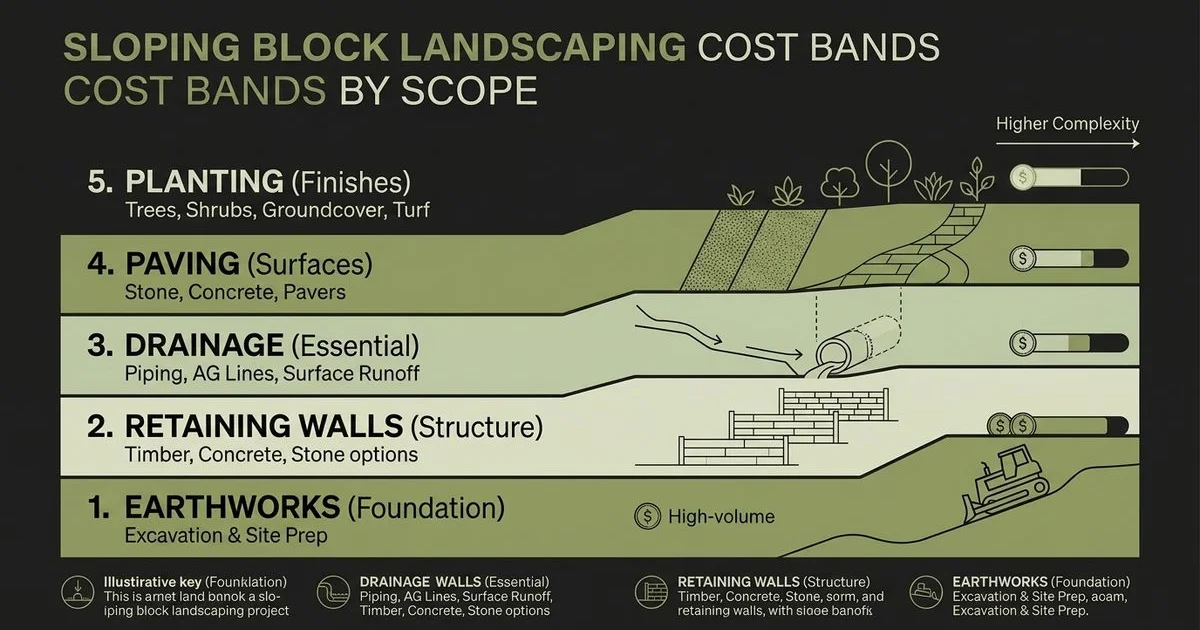
Projects on a gradient typically cost 50 to 100 percent more than flat sites of the exact same size. This sloping site landscaping price in Victoria is driven by heavy infrastructure and access challenges. We find that flat blocks completely skip four major expenses that hillside properties demand.
- Retaining infrastructure: Expect to fund single tall barriers or tiered terracing systems (see retaining walls vs terraced gardens).
- Drainage networks: You will need agricultural piping behind every wall and surface-water management across the entire gradient (see sloping block drainage).
- Engineering and permits: Local councils require structural certificates for any wall over one metre high.
- Access and machinery: Tight-access labour rates and heavy excavator hire add significant daily fees.
Our experience in Melbourne’s eastern suburbs reveals another hidden cost driver. Reactive clay soils in areas like Manningham and Nillumbik demand deeper 600-millimetre footings rather than the standard 300-millimetre depth. This geotechnical reality instantly increases structural requirements.
We also have to account for the Victorian Environment Protection Authority waste levy. Soil disposal now costs $169.79 per tonne for metropolitan municipal waste in 2026.
These premiums are absolutely justified by the final result. Engineered slope work easily outlasts standard flat-block soft landscaping by decades when completed correctly.
Project Cost Bands
Clear pricing helps you plan a realistic budget before starting the design phase. These 2026 Victorian construction-cost bands for residential landscape work exclude initial design fees. We updated these figures to reflect current material rates and structural engineering requirements.
| Project Scope | Typical Range | Drivers |
|---|---|---|
| Single-terrace courtyard, 8 to 15% slope | $40,000 to $80,000 | One retaining tier, basic drainage, planting |
| Two-terrace suburban, 15 to 25% slope | $120,000 to $250,000 | Two walls, full drainage, paved zone |
| Multi-terrace whole-block, 20 to 30% slope | $250,000 to $600,000 | 3 to 4 walls, switchback access, planting at scale |
| Steep estate / acreage, 25%+ slope | $500,000 to $2,000,000+ | Engineering-led, multi-stage build |
| Pool integration on slope | +$80,000 to $250,000 | On top of base sloping-block work |
These base bands cover retaining structures, drainage, hardscaping, planting, and project management. Engineering certificates and council permits generally add another 4 to 8 percent on top of these figures.
Our teams always recommend securing a formal structural assessment early to lock in your specific permit costs. A standard structural engineer report in Melbourne currently costs between $600 and $2,000 depending on the site.
Where the Money Goes
A typical hillside construction quote distributes funds across several specialised categories. The majority of your budget goes directly into structural integrity and water management. We see earthworks and retaining acting as the biggest financial variables on any steep site.
Standard Budget Breakdown
Here is how a standard quote divides the total project cost:
- Retaining walls (materials, footings, drainage): 30 to 40%
- Hardscape (paving, paths, decking): 15 to 25%
- Drainage and infrastructure: 8 to 15%
- Cut and fill or earthworks: 8 to 12%
- Planting and irrigation: 12 to 20%
- Project management and supervision: 8 to 10%
- Engineering certificates and permits: 3 to 6%
Hidden Compliance Costs
Compared to a flat-block project, the retaining and earthworks categories represent entirely additional expenses. The drainage category is also significantly larger due to gravity-fed water risks. We know that soft landscaping costs remain roughly the same once the terraces are actually built.
You must also budget for neighbouring property protections if you build near boundaries. Councils like Nillumbik and Manningham strictly enforce Protection Work Notices under the Building Act 1993.
Our site managers handle these notices, but they require additional land surveys and specialised insurance before any excavation begins. This legal compliance protects both you and your neighbours from structural risks.
Staging the Build
Splitting the project into two distinct phases is the most effective way to manage steep terrain. This two-season staging approach spreads the financial commitment while improving the final result. Our project timelines frequently divide the heavy infrastructure from the delicate finishing work.
Phase One: Structural Foundation
Year one tackles the heavy lifting and critical engineering. This phase includes the major cut and fill, retaining wall construction, deep drainage installation, and core hardscaping.
We prioritise establishing a safe, stable site that can weather the Melbourne winter without erosion. This initial stage consumes the bulk of your budget but secures the property.
Phase Two: The Soft Finish
Year two shifts focus entirely to the visual finishing touches. Contractors will install planting at scale, run the lighting, commission the irrigation, and apply establishing mulch.
Our clients appreciate that plants go directly into garden beds that have already settled naturally after the construction disruption. The total cost remains very similar across both methods.
You might pay slightly more for a second site mobilisation, but the improved cash flow makes a massive difference. Most homeowners who choose this phased approach feel much less financial pressure.
Cost-Saving Strategies That Hold Design Intent
Smart material choices allow you to reduce expenses without sacrificing the final aesthetic. Strategic compromises protect your budget while keeping the core engineering solid. We strongly advocate for saving money on finishes rather than structural foundations.
Where to Safely Economise
You can make several immediate adjustments to lower your total quote.
- Material switching: Use highly functional, $350-per-square-metre concrete sleepers for hidden retaining walls at the back of the block. You can then reserve premium bluestone for the highly visible front entrance.
- Planting density and infill: Begin your garden with a 60 percent planting density. We recommend filling in the remaining gaps during year two once the initial plants establish their root systems.
- Deferred lighting installation: Design the cable runs during the initial earthworks phase. You can easily purchase and install the actual light fittings a year later.
Where You Must Never Cut Corners
Certain elements are absolutely non-negotiable on a severe gradient.
- Drainage: Under-specified agricultural lines and poor surface-water management create devastating erosion. Retrofitting drainage behind a completed wall is the single most expensive mistake a homeowner can make.
- Engineering: Under-built retaining systems will inevitably fail under the weight of wet Melbourne clay. Our engineers warn that a collapsed wall takes the entire slope and all your new planting down with it.
- Project management: Sloping-block construction features far more moving parts than a standard flat backyard. Cutting back on site supervision guarantees a drop in build quality and safety.
A challenging site offers incredible design potential when you understand the foundational numbers. Preparing for your sloping block landscaping cost ensures a smooth, stress-free build process.
We encourage you to gather your site plans and start a conversation with a qualified structural expert. Reach out to a registered landscape architect today to arrange a site consultation and begin mapping out your hillside transformation.