Guides
Drainage and Erosion Control on Sloping Blocks
How ag-line networks, geotextile and surface-water management prevent the failures that take out under-drained sloping blocks in Melbourne's clay-loam profile.
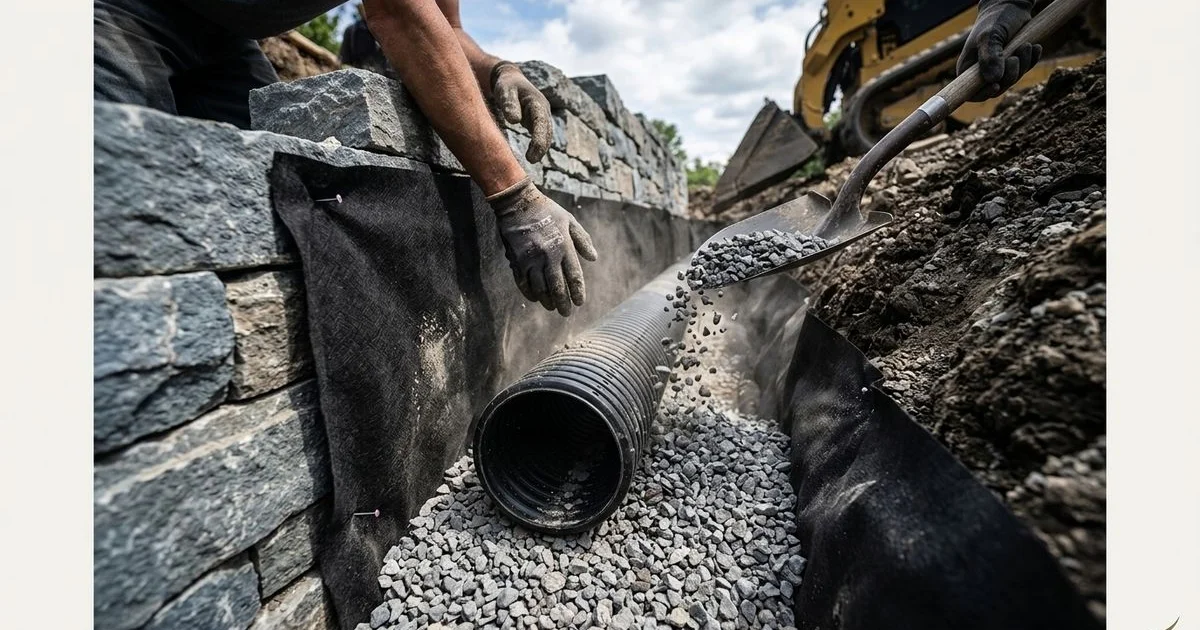
Our team at David Claude Landscape Design handles premier landscape architecture and construction for the most challenging properties in Melbourne. This unique terrain requires specific attention to detail.
We see the same hidden issues ruining expensive outdoor projects across the north-eastern suburbs.
Reactive clay soil and unpredictable rain events create a worst-case scenario for steep gradients.
Let’s look at the data, what it actually means for your property, and how to implement the exact sloping block drainage systems necessary for structural longevity.
Why Drainage Is the Critical System
Water shed by Melbourne’s seasonal rainfall does not just disappear. On a sloping block, it runs downhill, accumulates against the upslope side of any retaining structure, and saturates the clay-loam profile beneath the surface. This trapped moisture increases hydrostatic pressure on every structural element it touches.
We know that without an engineered drainage setup, that pressure eventually exceeds what the materials can hold. The resulting strain causes complete failure.
Our experience shows that structural failures rarely announce themselves immediately. The wet patch lingering in the corner of your garden through three winters is often the first clue.
We highly recommend acting quickly if you notice these early warning signs:
- Persistent ponding behind the structure.
- Stepped cracks forming along mortar joints.
- A noticeable forward lean or bowing.
- Weep holes that remain completely dry after heavy rain.
Our structural repair crews find that most leaning walls lack original drainage planning. By the time the barrier bows forward visibly, the structural damage is already serious. In areas like Banyule and Manningham, the local reactive clay expands significantly when wet and shrinks during dry spells.
We understand this constant movement places immense stress on footings. According to recent Bureau of Meteorology data, Melbourne receives around 649mm of annual rainfall, often delivered in sudden, heavy downpours. These intense storms can saturate the ground within minutes.
The Standard System
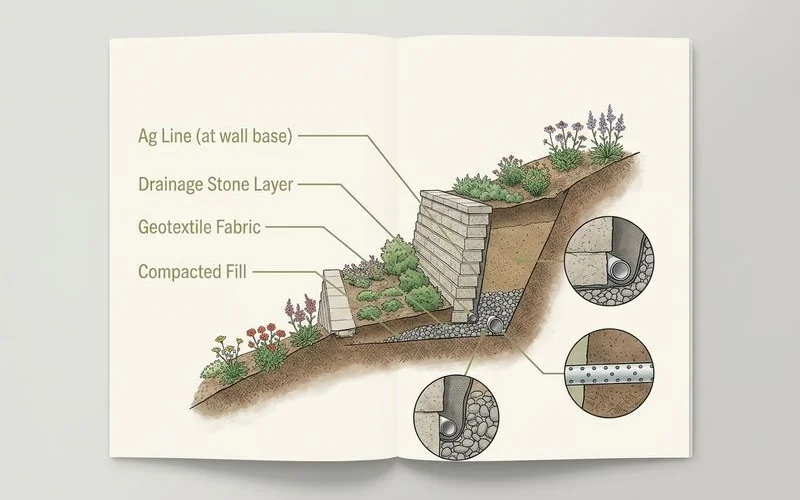
Every retaining wall we build has the same drainage stack behind it, regardless of material. This baseline standard is crucial for compliance and durability.
We adhere strictly to the Australian Standard AS 4678 for earth-retaining structures. This national code mandates specific drainage provisions for any barrier higher than 800mm to prevent collapse. The setup is unglamorous and largely invisible once finished.
Our standard stack relies on four key components to keep water moving freely. A reliable layout is the single biggest determinant of whether the barrier lasts five years or fifty.
- Ag-pipe: 100mm slotted agricultural pipe sits at the base of the foundation, sloped to a designated stormwater outlet.
- Drainage stone: Coarse aggregate, typically 20mm or 40mm, backfills the space around and above the ag pipe drainage retaining wall setup to allow rapid water movement.
- Geotextile fabric: A permeable Bidim non-woven membrane wraps around the drainage stone to keep clay fines out.
- Engineered fill: Compacted soil covers the geotextile, creating a stable surface ready for planting or hardscaping.
We prefer Bidim continuous filament polyester geotextile because its three-dimensional structure allows high water flow while effectively blocking fine clay particles. Clogged pipes are the primary reason older walls fail.
Our crews ensure the fabric completely envelops the drainage trench. This method greatly improves the efficiency of the entire system over decades of use.
Surface Water Management
Sub-surface drainage is never enough on its own. Our site plans must also handle surface water, which is rain that sheds across the slope without infiltrating the ground.
Proper management directs this runoff into council stormwater infrastructure or designated on-site retention pits. The standard tools include surface channels at terrace transitions, spoon drains across paved areas, and drainage pits at low points.
We always verify the gradients to ensure water flows efficiently away from structures.
Local Guidelines and Gradients
Victorian plumbing regulations, like AS/NZS 3500.3, outline specific gradient rules for residential properties. Our paving teams translate these requirements into precise, measurable slopes to prevent pooling and water damage.
| Surface Type | Minimum Fall Requirement | Primary Purpose |
|---|---|---|
| Paved Areas | 1:100 (10mm per meter drop) | Prevents surface pooling and localized flooding |
| Garden and Lawn | 1:60 to 1:40 slope | Directs heavy runoff to surface channels |
| Overland Flow Paths | 300mm freeboard clearance | Protects structural floor levels from flood damage |
Melbourne Water guidelines also dictate strict clearances for residential developments. We design finished surface levels adjacent to overland flow paths to sit at least 300mm above the calculated 100-year flood level.
This freeboard provides a critical safety margin during extreme weather. On steep blocks, the surface water budget can easily exceed the sub-surface budget.
Hydrostatic Pressure: The Force That Breaks Walls
Hydrostatic pressure is the literal force exerted by saturated soil and standing water against a solid element. Our structural calculations show that trapped water creates a massive horizontal load.
On a 2m retaining wall holding back saturated clay, the pressure can exceed 2 tonnes per square metre. We consider this a load that most under-built or poorly drained structures simply cannot accommodate over time.
To put this into perspective, water density adds approximately 10 kPa of lateral force for every meter of depth.
Calculating the Lateral Load
Our engineers know that a fully saturated backfill effectively doubles the lateral force compared to a well-drained soil profile. Heavy summer storm events cause the ground behind a barrier to fill with water rapidly.
Engineered design calculates the expected hydrostatic load and sizes the footing depth, reinforcement, and batter angle to resist it.
We reduce that dangerous load by using the drainage stack to keep the soil from saturating in the first place. Both the structural engineering and the water management must be absolutely correct.
Erosion Control During Construction
Construction-phase erosion presents a completely different set of challenges. Our site managers know that a stripped slope without temporary protection can lose serious topsoil in a single rain event.
Standard practice involves installing silt fences along contour lines during the cut and fill process. We also utilize temporary erosion mats on bare slopes and construct sediment ponds at the bottom of long catchments.
Hydroseeding or temporary planting is essential for slope erosion control on sites that will sit exposed for more than a few weeks.
EPA Compliance and Fines
Our compliance officers strictly follow the EPA Victoria Publication 1834 guidelines for civil construction. The EPA rigorously enforces sediment control across Melbourne.
Allowing silt to enter a stormwater drain can result in a fine exceeding $5,900 for a minor breach. To prevent these issues, silt fences made from permeable woven geotextile are trenched into the ground and supported by star pickets.
We actively monitor these temporary barriers after every major rain event. Maintenance requires shoveling out the collected sediment once it reaches one-third of the fence height.
The goal is not to lose any soil between the initial cut and the final planting. Soil that ends up in the council stormwater system becomes the council’s problem.
Our environmental measures ensure that soil never washes into your downhill neighbour’s pool, which is everybody’s problem.
Planning Your Next Steps
For the wall-by-wall detail on drainage, see our guide on drainage behind retaining walls. We explain the broader context of slope design in our article on is my block too steep to landscape.
Proper sloping block drainage is an investment that protects your entire property.
Our team is ready to evaluate your site and design a comprehensive solution that meets all local standards. Contact David Claude Landscape Design today to schedule a site assessment and secure your landscape’s foundation.