Guides
How to Drain a Retaining Wall (and Why It Matters)
Why drainage is the single biggest variable in retaining wall longevity, and how ag-pipe, drainage stone and geotextile work together to relieve hydrostatic pressure.
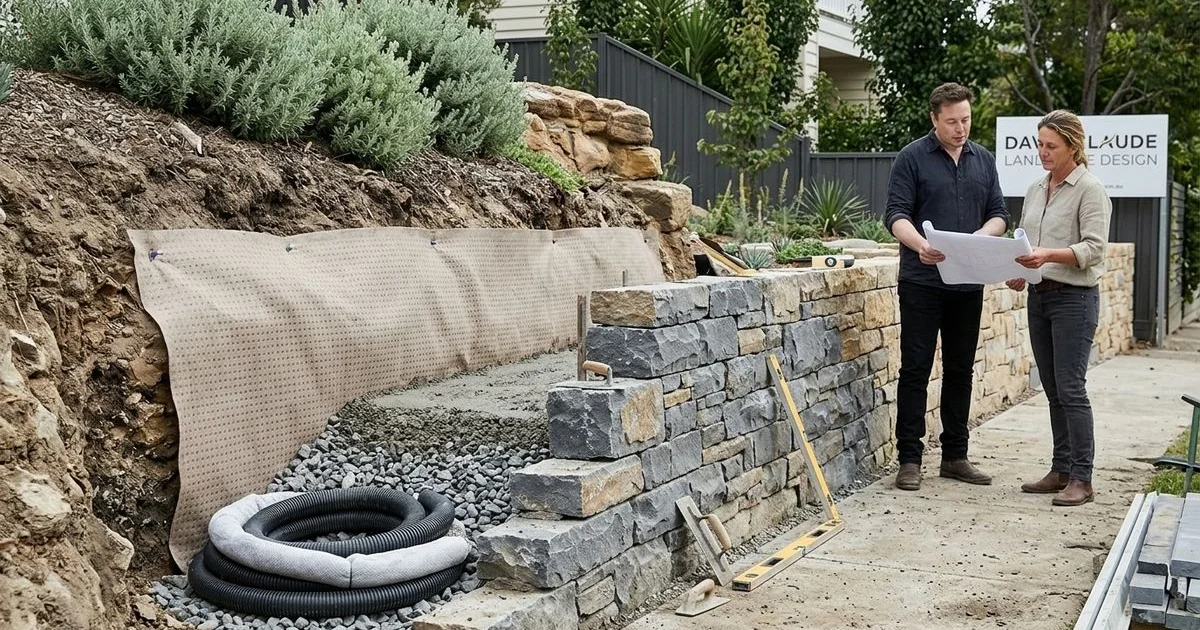
We at David Claude Landscape Design know the frustration of watching a beautifully constructed landscape buckle under the hidden weight of poor site preparation. From what I have seen across Melbourne’s sloped blocks, the difference between a lasting feature and a costly disaster always comes down to proper retaining wall drainage, which is the one element you cannot see.
Our team finds that managing moisture is the single most critical factor for these structures, especially in challenging terrain.
Let’s look at the data on soil pressure, what it actually means for your backyard, and explore the precise methods required to protect your investment.
Why Drainage Matters
We know that retaining walls fail for very predictable reasons. The biggest culprit by a wide margin is consistently poor retaining wall drainage.
Our local experience in Melbourne’s north-eastern suburbs, like Eltham and Macleod, shows that the highly reactive clay soil acts like an aquitard, holding water instead of absorbing it. Water shed by heavy rainfall and surface runoff accumulates behind the wall, saturates the earth, and exerts immense hydrostatic pressure against the structural face.
We calculate that this pressure increases rapidly with the saturated soil column height. At typical residential wall heights, the outward hydrostatic pressure retaining wall sections must support can easily exceed 2 tonnes per square metre.
Our structural engineers confirm that a correctly engineered wall sized for retained dry soil simply cannot resist this saturated load over time. Walls without proper drainage tilt forward, crack, and eventually fail, sometimes catastrophically.
Our approach treats drainage not as a finishing detail, but as a critical structural element.
The Standard Drainage Stack
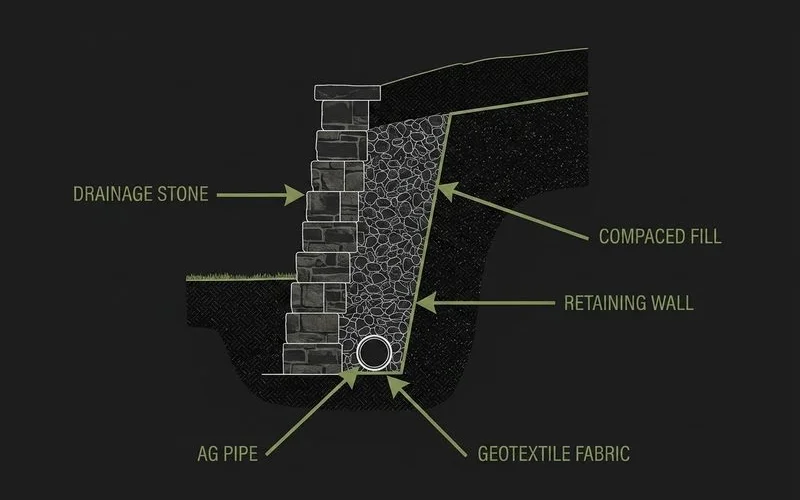
We install a comprehensive drainage stack, including a high-capacity ag pipe behind retaining wall structures we build, regardless of the facing material. This system provides a clear path for water to escape before pressure builds up. Our preferred setup consists of five essential layers.
- Ag-pipe: 100mm slotted PVC agricultural pipe at the base of the wall, sloped at a minimum 1% fall down to a council stormwater outlet.
- Drainage stone: Coarse aggregate (typically 20mm blue metal or honey granite with no fines) backfilled around the ag-pipe and up the back face of the wall.
- Geotextile fabric: A premium non-woven permeable membrane, such as Australian-made Bidim Green, wrapped around the drainage stone to keep clay fines from migrating in.
- Engineered fill: Compacted topsoil or structural fill placed above the geotextile layer.
- Surface water management: The surface above the wall precisely graded to direct stormwater away from the back of the wall.
This system is largely invisible once finished. Our data proves it is also the single biggest determinant of whether your wall lasts five years or fifty.
How the System Works
Our designs rely on gravity and permeability to keep the structural face safe. Surface rainfall infiltrates the topsoil and percolates downward.
Our site assessments show that when the water hits the Bidim geotextile layer, it passes right through because the membrane is highly permeable to moisture but blocks reactive clay particles. The water then flows freely through the drainage stone.
| Component | Primary Function |
|---|---|
| Bidim Geotextile | Blocks clay fines, allows water passage |
| 20mm Aggregate | Provides high void space for rapid water descent |
| 100mm Ag-Pipe | Collects and channels water to the council outlet |
We rely on coarse 20mm aggregate because it has high void space, meaning water moves down to the ag-pipe quickly without saturating the soil column. The ag-pipe collects this water efficiently.
Our installations convey it to a stormwater outlet, an on-site retention tank, or a soakage system under steady gravity. The wall stays dry and the hydrostatic pressure stays incredibly low.
Our clients enjoy peace of mind knowing the structure performs flawlessly to its design life.
Where Drainage Goes Wrong
We frequently encounter three specific failure modes when replacing collapsed walls in the inner-eastern suburbs.
Missing Ag-Pipe
The most severe cases occur when builders omit the ag-pipe completely. Our inspections reveal topsoil packed directly against the timber or concrete structural face. Water has absolutely nowhere to go. We see the wall leaning heavily forward within a few wet seasons.
Missing Drainage Stone
A second issue arises when an ag-pipe is present but no drainage stone is installed. We find that water has to slowly percolate through dense clay soil to reach the pipe, which is far too slow to keep up with intense 2026 rainfall events. The system is completely overwhelmed during heavy summer storms.
Missing Geotextile
We observe a third scenario where drainage stone is present but lacks a protective geotextile. Microscopic clay fines migrate into the stone over a few seasons, which permanently clogs the vital void space. Our repair crews see the drainage immediately stop working, causing the wall to start leaning.
Rectifying these mistakes is incredibly expensive. We base this on recent 2025 local data indicating that replacing a moderately sized, failed retaining wall in Melbourne averages between $6,000 and $14,000. Retrofit usually means excavating the back of the wall, removing established planting, rebuilding the entire drainage stack, and completely replacing the damaged structural face.
Surface Water Management
We know that sub-surface drainage simply is not enough on its own. The surface above the wall has to be deliberately graded to direct stormwater away from the back of the wall.
Our standard practice requires a 2% fall for at least one metre beyond the wall, using surface drainage channels where the uphill catchment area is large. Without this dedicated surface management, the hidden drainage stack is constantly overwhelmed by sheer sheet flow.
We are ready to help you plan the right retaining wall drainage approach for your property.
For the material decision, see the dedicated guide. Our team invites you to explore the broader retaining wall service on the main hub page to get your next project started correctly.