Guides
Garden Lighting Fundamentals: Layers, Colour Temperature, Beam Angles
How layered design, warm colour temperature and beam-angle discipline turn a residential garden into a different (and better) space at dusk.
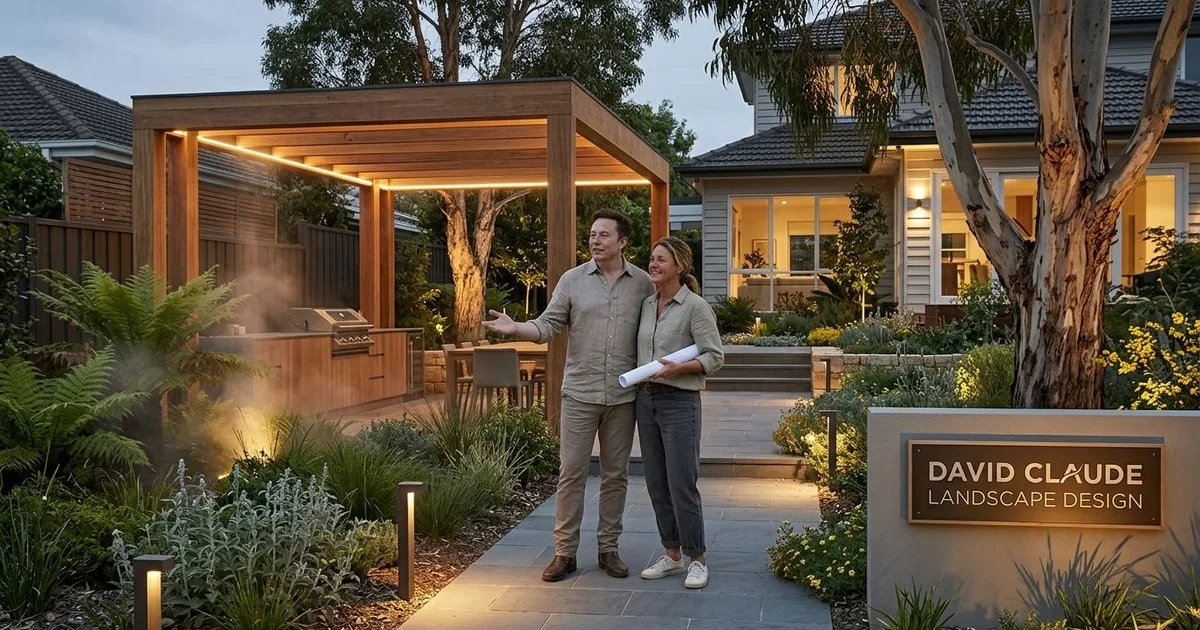
We often find that night-time presentation is the most misunderstood aspect of garden lighting design fundamentals. A property that feels expansive during the day can easily shrink into a flat, dark box if the illumination is handled poorly.
Our team at David Claude Landscape Design sees this constantly across Melbourne’s north-eastern and inner-eastern suburbs, where challenging terrain requires a strategic approach. Getting the balance right transforms a steep, sloped backyard into an inviting, multi-level living space.
We will break down the principles of landscape lighting layers, examine proper outdoor lighting colour temperature, and outline the specific techniques needed to make your property shine.
The Three-Layer Principle
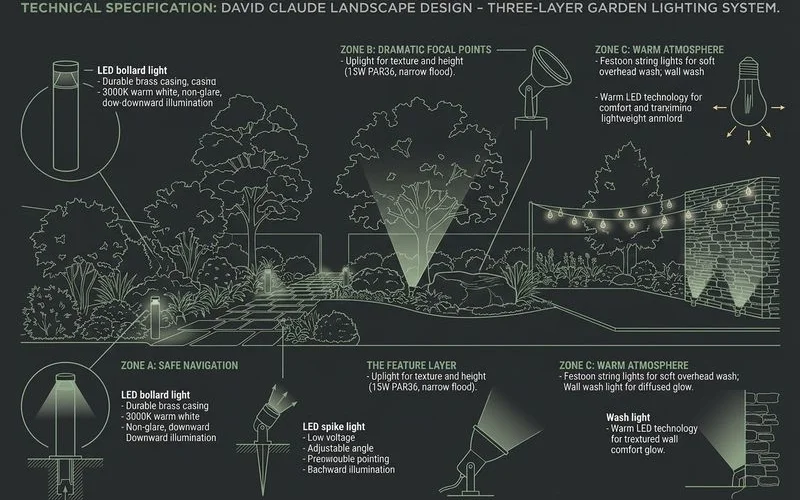
Standard professional practice dictates that a well-lit residential garden requires three distinct zones working in harmony. We approach every project by balancing a path layer, a feature layer, and an ambient layer.
Skipping even one of these elements leaves the outdoor space feeling either like a sterile corridor or a theatrical stage set. Our designers know that getting all three layers working together ensures the garden reads at night exactly the way it does at dusk.
Recent 2026 industry data shows that balancing these specific zones increases the usable footprint of a property by up to 40 percent after dark. We use this proven method to give the landscape extended hours, layered depth, and soft visual transitions.
| Layer | Typical Fittings | Primary Purpose | Lumen Range |
|---|---|---|---|
| Path Layer | Bollards, step lights | Safe navigation on uneven ground | 100-150 lumens |
| Feature Layer | Uplights, wall washers | Drama and structural highlighting | 250-600 lumens |
| Ambient Layer | Soffit lights, pergola wash | Background atmosphere and depth | 1,000-1,500 lumens |
Sloping blocks benefit immensely from this structured approach, as the distinct zones help connect different tiered levels without harsh visual breaks. Our clients frequently tell us that this three-tier strategy turns their difficult, steep backyards into their favourite evening entertaining areas.
Colour Temperature Discipline
Colour temperature is measured in Kelvin (K), and professional standards dictate staying exclusively within the 2700K to 3000K range for residential gardens. We enforce a strict rule when selecting bulbs to ensure the outdoor environment feels inviting rather than clinical.
Warm white specifically flatters the muted greens of Australian native foliage like eucalypts, banksias, and westringia. Our preferred 2700K tone pairs beautifully with the warm hues of bluestone, spotted gum, and natural stone hardscaping.
Avoiding the Clinical Glow
Neutral white sits at 3500K to 4000K, while anything 4000K or above reads as cool, commercial, and industrial. We standardise on 2700K for warm, intimate spaces like terraces, and use 3000K for broader feature accents where the slightly cooler tone reveals foliage detail.
Mixing colour temperatures across a single sightline is a common mistake that makes a space look completely unintentional. Our installation teams guarantee the whole garden uses a unified tone for a cohesive finish.
Certain temperature choices ruin an otherwise perfect design:
- Installing 4000K floodlights that wash out the subtle textures of natural stone retaining walls.
- Failing to match the garden’s lighting temperature with the interior bulbs visible through adjacent windows.
- Using glaring white security lights instead of warm, shielded alternatives.
- Mixing 2700K and 3000K indiscriminately within the same garden bed.
We acknowledge that there is a place for cool white in security floodlighting or garages, but it does not belong in a carefully curated backyard.
Beam Angle and Fitting Selection
Narrow beams of 15 to 25 degrees are perfect for tree uplights, while wider 40 to 60-degree beams handle path washing and ambient effects. We carefully select beam angles to dictate how illumination spreads across different landscape elements and steep inclines.
High-quality fixtures must survive harsh Melbourne weather, so powder-coated aluminium or marine-grade 316 stainless steel are the required standard for 2026. Our designs prioritise fitting quality just as heavily as the choice of the bulb itself.
Specific situations call for exact hardware choices:
- Path lights: Low bollards around 300 to 500mm tall require dark-finish housing that disappears into the planting during the day.
- Tree uplights: Ground-recessed or low-spike fixtures aimed up into the canopy must be shielded to prevent harsh glare.
- Wash lights: A wider beam with lower brightness works best for highlighting the rugged textures of stone retaining walls.
- Step lights: Recessed units built directly into stair risers serve as critical safety markers on sloping, multi-level blocks.
- Soffit lights: Hardware hidden in eaves and pergola undersides provides an ambient glow without revealing the source.
We often find that integrating lighting early during retaining wall construction saves significant time and money compared to retrofitting cables later. Small, recessed wall accents create a stunning visual flow that safely guides the eye from one terraced level to the next.
Switching and Control
We always recommend an automated schedule with a manual override for maximum convenience. Smart-home integration is no longer a luxury, and most homeowners now prefer a system that manages itself based on the time of day.
Our technicians frequently integrate landscape setups with reliable platforms like SpaceLogic C-Bus, Wiser Home Control, or Lutron. These advanced systems allow for custom scenes, such as an entertaining mode that activates the feature layer at the touch of a single button.
We program several standard automation patterns for our clients:
- Sunset-on scheduling: An astronomical timer activates the path and ambient layers precisely at dusk.
- Separate feature circuits: The dramatic tree and wall accents remain switched off until needed for entertaining.
- Sensor integration: Motion sensors handle functional zones like side passages and bin areas without keeping them illuminated constantly.
- Midnight blackout: A default all-off command at midnight manages power use and complies with local dark-sky guidelines.
Managing your outdoor environment through a dedicated smartphone app makes adjusting schedules effortless as the seasons change. Our team can even link garden illumination to your security alarm, ensuring all exterior fixtures flash bright if an intruder is detected.
Avoiding Light Pollution
Designed residential garden lighting should highlight the landscape, not blind the people living next door. We construct residential setups to intentionally minimise unnecessary spill into neighbouring properties and the night sky.
Modern LED technology produces ample brightness using just 5 to 8 watts per fitting, meaning lower wattage is usually the smartest choice. Our commitment to responsible illumination aligns perfectly with Victoria’s growing focus on dark-sky compliance.
Practical rules for reducing light pollution include:
- Specifying shielded fittings that direct the beam downward onto paths rather than up into bedroom windows.
- Aiming for the minimum effective brightness instead of the maximum visible output.
- Using automated schedules so fixtures are not left burning needlessly through the early hours of the morning.
- Positioning uplights carefully so the dense tree canopy catches the beam, stopping it from shooting freely into the atmosphere.
We explore the technical differences between power sources in our low-voltage vs solar comparison guide. Finding the right balance of efficiency and aesthetics is essential, so check out the broader garden lighting service hub for more technical details.
Our team is ready to evaluate your current setup and help you design a nocturnal space that truly maximises your property’s potential. Reach out today to schedule a site consultation and take the next step in transforming your landscape.