Guides
Landscape Design and Construction Costs in Victoria
Realistic project bands for Victorian landscape design and construction, broken down by scope: courtyard, suburban block, acreage and steep-block premium.
We hear the same question from homeowners across Melbourne every single week. Understanding the true landscape design cost victoria requires looking past the surface level.
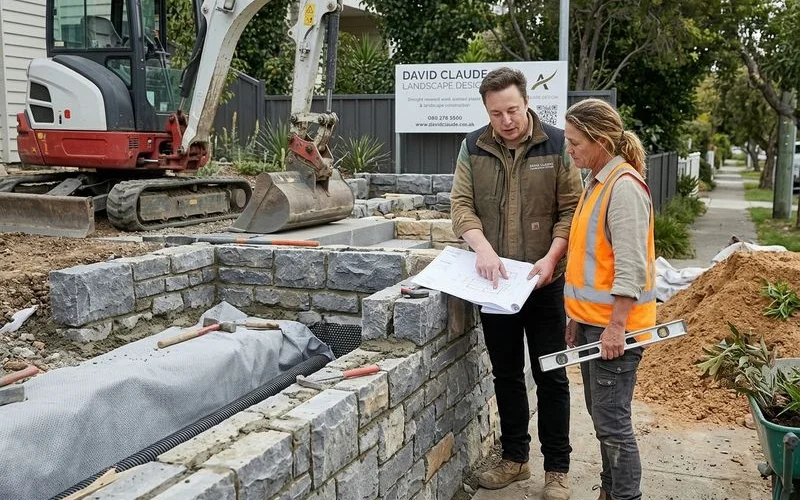
Our team at David Claude Landscape Design routinely evaluates challenging, sloping sites in the eastern suburbs. You know how quickly a simple garden plan changes when soil retention and drainage issues appear.
We see hidden engineering become the primary budget driver on nearly every project.
Let’s examine the current 2026 material rates and show you a few practical ways to manage your budget.
What Drives Landscape Design Cost Victoria
We evaluate five specific variables that drive landscape construction cost in Victoria, ordered by their rough financial impact. These core elements dictate the final numbers on every quote you will receive.
- Scope: A courtyard refresh requires far less capital than a full block master plan or an acreage estate.
- Slope: Flat blocks are cheaper than sloping ones by a wide margin.
- Material category: Our recent 2026 data shows concrete sleeper retaining ($300 to $450 per square metre) versus premium bluestone retaining ($600 to $780 per square metre) is roughly a 1:3 cost ratio.
- Engineering and permits: Over-1m walls, Bushfire Management Overlay (BMO) compliance, and council planning permits add 8 to 15 percent to the total.
- Access: Tight inner-suburban blocks with no machine access run higher than acreage where heavy equipment can work.
Our projects in eastern areas like Boroondara frequently encounter strict council overlays that require structural engineering. Most clients underestimate the impact of slope and engineering on their final bill.
We remind homeowners that high-end projects exceeding a $1,311,000 estimated cost now trigger the Metropolitan Planning Levy (MPL). A flat block with simple lawn-and-bed planting is straightforward.
We know a steep block with terraced retaining, ag-line drainage, and a switchback driveway falls into a completely different category. The final cost heavily reflects the necessary engineering and labour discipline.
Project Cost Bands
Our construction-cost bands reflect premium residential landscape work in Victoria for 2026. These figures provide realistic ranges, exclusive of design fees and council permit costs.
| Project Type | Typical Range | Drivers |
|---|---|---|
| Courtyard / single-zone refresh | $15,000 to $40,000 | Material, scope, planting density |
| Suburban block (flat, 600m²) | $80,000 to $200,000 | Hardscape area, planting maturity |
| Suburban block (sloping) | $150,000 to $400,000 | Retaining, drainage, terracing |
| Pool surround integration | $40,000 to $300,000 | Coping material, fencing, planting |
| Heritage refurbishment | $100,000 to $350,000 | Tree protection, period materials |
| Acreage master plan | $250,000 to $1,500,000+ | Scale, infrastructure, staging |
| Steep estate (multi-stage) | $400,000 to $2,000,000+ | Engineering, retaining, drainage |
We include soft landscape, hard landscape, drainage, and project management in these estimates. The bands remain strictly exclusive of the pool shell, swimming pool installation, and house construction.
Our teams find that hardscaping alone consumes 40 to 50 percent of a typical suburban budget. Breaking your project into phases is a highly effective way to spread costs over several years while living with a functional garden.
Design Fees
Standard Fee Structures
We typically see design fees in Victoria running 5 to 12 percent of the eventual construction value. Full-design packages for complex sloping sites generally fall between $7,000 and $20,000 today.
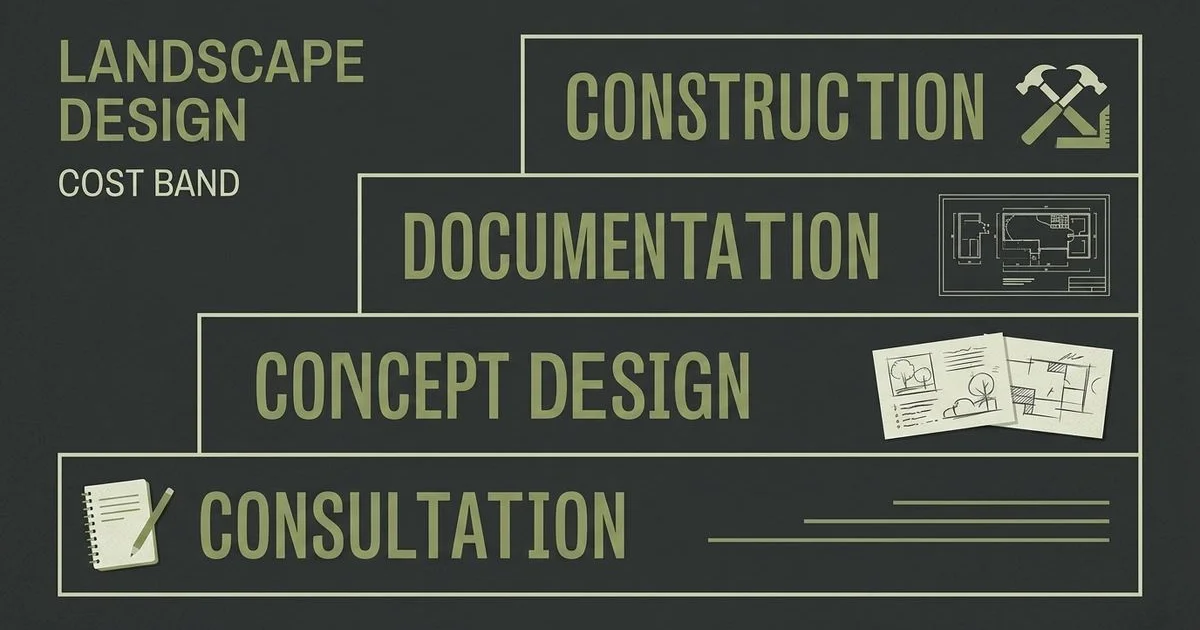
Our fee split operates on a predictable schedule across three main milestone deliverables. The split runs roughly:
- Concept (around 25% of the fee): mood boards, 2D plans, high-end 3D renders, and material direction.
- Documentation (around 50% of the fee): construction drawings, planting plans, and Water Sensitive Urban Design (WSUD) council documentation.
- Construction support (around 25% of the fee): site visits, builder coordination, and certificates of compliance.
Billing and Flexibility
We bill these fees as a fixed-fee per stage against these deliverables, never hourly. The design fee structure remains completely independent of the final construction cost.
We hand over the complete documentation so you can have it built by a different team if you choose. Most clients prefer to use the integrated design and construction process to ensure accuracy on site.
Where the Money Goes
The Heavy Lifters: Hardscaping and Plants
We regularly break down quotes for sloping-block construction to show clients exactly where their budget goes. A typical comprehensive quote breaks down roughly:
- Hardscape (paving, retaining, structures): 50 to 60 percent
- Planting (stock, installation, mulch): 15 to 25 percent
- Drainage and infrastructure: 8 to 15 percent
- Project management and supervision: 8 to 12 percent
- Engineering certificates and permits: 3 to 6 percent
Our data shows the largest single category is almost always hardscape, including bluestone, natural stone, and structural retaining. These specific materials are expensive, and the labour required to install them is skilled and slow.
We identify planting as the second-biggest cost on most residential jobs. Plant maturity dramatically changes this figure, as a 100-litre advanced feature tree costs substantially more than standard tubestock.
Infrastructure and Oversight
Our crews know that retaining walls over 1 metre tall mandate specific structural engineering permits in Victoria. These mandatory certificates add significant administrative time and cost to the groundwork phase.
We recommend staging plant installations across multiple seasons to ease the budget. This approach reduces upfront spending without compromising the integrity of the design.
Why Cheap Quotes Are Usually Missing Something
Identifying the Missing Scope
We warn homeowners that a landscape quote coming in 30 percent below comparable bidders is usually missing critical scope. The most commonly omitted category is proper drainage, which is the absolute most expensive thing to retrofit later.
Our audits of cheap quotes frequently reveal missing planting establishment items like irrigation, mulch top-ups, and replacement guarantees. Many low bids also ignore council permit overhead, such as Bushfire Management Overlay (BMO) compliance and retaining-wall engineering certificates.
The Hidden Cost of Poor Supervision
We know that project management is another frequent omission, leaving no one on site to supervise the actual build. Ask each bidder to itemise across these categories and compare them line by line based on square metres.
We find that a correctly scoped quote looks more expensive initially. The missing-scope quote always ends up costing more once the omissions surface during the build.
Cost-Saving Strategies That Don’t Compromise the Design
Smart Material and Phasing Choices
We frequently answer the question of how much does landscape design cost melbourne by implementing three proven strategies. These specific methods protect the structural integrity of your garden without diluting the design intent.
- Stage the build across two seasons: Complete the hardscape this year, then tackle planting and lighting next year.
- Switch material categories selectively: Use concrete sleepers for back-of-block retaining, while keeping bluestone for the visible terraces.
- Reduce planting density and add to it over time: Start with 60 percent of the eventual plant count and infill at year two.
Our designers highly recommend switching material categories selectively based on visibility. Using concrete sleepers at $350 per square metre saves thousands compared to premium natural stone.
Planting Density and Non-Negotiables
We suggest reducing initial planting density as a safe, temporary budget measure. You can easily infill the remaining garden beds later as your budget replenishes.
We never advise skipping drainage, ignoring engineering requirements, or bypassing the professional design stage. Each of those poor decisions costs far more in the long run than the initial design fee or the engineering certificate ever would.
We hope this breakdown clarifies the true landscape design cost victoria for your property. Understanding the difference between a realistic estimate and a missing-scope quote protects your investment.
Our team is ready to review your site and provide a transparent, fully itemised plan. Contact us today to schedule your initial consultation and secure an accurate assessment of your sloping block.