Guides
Pool Landscaping on a Sloping Block: Multi-Level Surrounds That Work
Multi-level pool surrounds, terraced retaining and AS1926.1 compliance on steep blocks across Warrandyte, Templestowe and the broader Melbourne north-east.
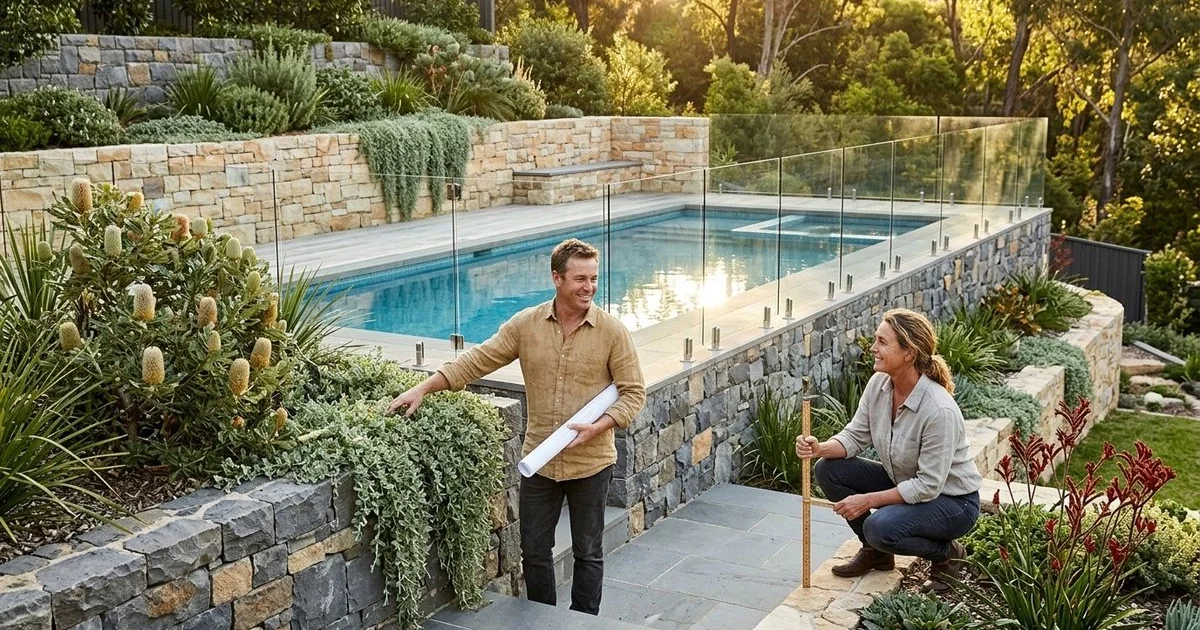
You already know that adding a pool landscaping sloping block design to a steep property completely changes the scope of a backyard project. Our team at David Claude Landscape Design has seen how a sudden gradient turns a standard build into an engineering puzzle.
Homeowners in Melbourne’s north-eastern and inner-eastern suburbs often face this exact challenge with their unique, undulating terrain.
We find that the dividing line between a successful project and a budget blowout usually comes down to structural planning. Let’s explore the data behind these builds, evaluate how proper terracing works, and map out a practical strategy for your landscape.
Why Sloping-Block Pool Work Is Specialist
Our designers know that building a pool on steep block Melbourne terrain demands a distinct set of engineering skills. Typical flat-block surrounds only require standard coping, paving, fencing, planting, and lighting on a single level.
We regularly handle sloping blocks that introduce several advanced requirements:
- Complex retaining walls to hold back heavy earth.
- Extensive, multi-tiered drainage networks.
- Multi-level circulation paths around the water.
- Strict compliance with AS1926.1 safety standards across shifting elevations.
Generalist landscapers often decline these jobs because structural engineering falls outside their daily practice. Our site analysts note that according to 2026 industry data, site preparation costs for a sloped site run 25% to 50% higher than flat ground.
Reactive clay soils, which are incredibly common in Melbourne’s eastern suburbs, require heavy remediation to prevent foundations from shifting. We combine pool expertise with specific steep-terrain experience to manage these unpredictable budgets effectively.
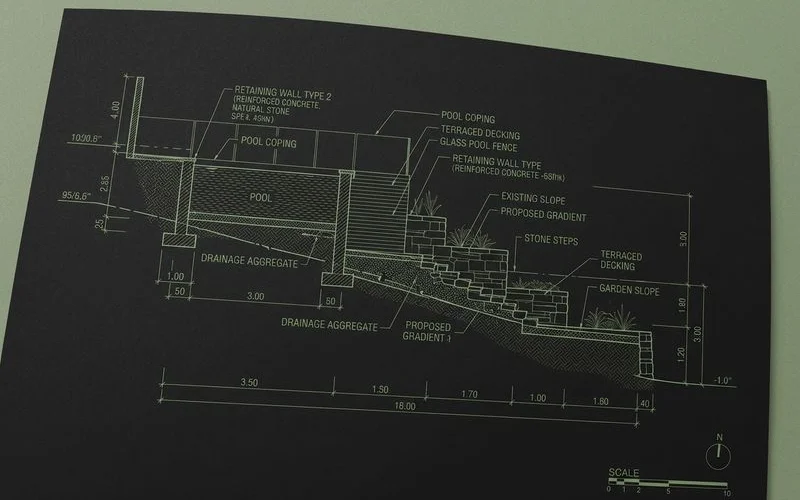
Where the Pool Sits
The first major decision involves determining the exact location of the water structure on your property. Our structural planners typically evaluate three common placement zones based on your site’s specific contour pattern:
- Upper section: Placing the pool at a higher elevation reduces excavation depth and cuts down on digging costs. Retaining requirements behind the pool stay minimal, while the surrounding views beautifully capture the falling slope.
- Mid-section: Spanning the middle of the slope usually requires a significant cut at the back and heavy fill at the front. The surrounding terraces step down gracefully on the lower side to create a striking central feature.
- Lower section: Dropping the structure to the lowest practical elevation captures excellent morning sun on north-falling blocks. High retaining walls at the back and lower walls at the front make this option pricier due to increased earthworks.
Deciding between these spots depends heavily on desired views, sun exposure, and privacy from neighboring properties. We always remind clients that any retaining wall over 1 metre high in Victoria requires a structural engineering certification and a formal building permit. Upward sloping blocks often allow gravity to handle stormwater, making drainage much easier than on downward slopes.
Multi-Level Surround Design
Our team rarely designs a multi level pool surround for a steep block as a single, flat surface. The most effective layout breaks the space into two or three distinct terraces that step gently down the landscape.
We typically deploy a standard framework that includes:
| Terrace Type | Typical Width/Drop | Primary Function |
|---|---|---|
| Pool deck terrace | 5 to 8 metres wide | Holds the immediate coping and primary surround paving. |
| Mid terrace | 600 to 800mm drop | Frequently provides a dedicated space for dining or seating. |
| Lower garden terrace | Variable transition | Softens the area with planting and connects to the wider yard. |
Each vertical transition relies on a retaining wall that includes comprehensive drainage systems hidden behind the structure. Our compliance experts ensure the primary pool deck terrace meets the strict AS1926.1-2012 safety standards for fencing.
The Victorian Building Authority mandates a minimum barrier height of 1200mm to pass certification. We carefully design a 500mm exclusion zone around any steps or level changes so children cannot gain a foothold.
Keeping the lower terraces outside the primary safety barrier removes the strict 900mm Non-Climbable Zone restrictions from those secondary entertaining areas.
Coordinating with the Pool Builder
We know that managing a project across uneven ground requires intense coordination between the landscaping team and the pool builder. The builder needs highly specific information before the excavator even arrives on site.
Our project managers clarify these exact details:
- Finished elevation levels around the entire perimeter, which change on every side for stepped surrounds.
- Precise coping widths and material choices to size the concrete shell edge correctly.
- Designated equipment locations that accommodate slope restrictions and limited maintenance access.
- Plumbing penetration positions for a cleaner, hidden finish on exposed walls.
- A clear construction access sequence to clear the slope efficiently.
Failing to engage a landscape designer before digging the shell almost always leads to expensive rework. We strongly recommend securing a geotechnical soil report for north-eastern Melbourne properties to assess soil stability before finalizing the engineering plan.
Steeper blocks often demand deep concrete or steel piers to anchor the structure securely into the bedrock. Our joint oversight keeps both the pool design and the landscape architecture moving forward without costly miscommunications.
Drainage on Sloping-Block Pool Surrounds
Managing water flow is arguably the most critical engineering challenge on any steep terrain. Our crews install heavy-duty drainage behind every single retaining wall to prevent structural failure.
Hydrostatic pressure from trapped rainwater can easily crack or push a concrete wall out of alignment. We rely on several essential water management strategies for steep sites:
- French drains: Installed behind retaining walls to relieve lateral soil pressure.
- Sump pits: Positioned at low points to collect and pump out heavy stormwater.
- Independent pit drainage: Essential for filter equipment stored below the water line.
- Surface grading: Directs everyday splash-out away from the pool shell.
Industry data for 2026 shows that drainage budgets for a sloping site typically run 30% to 50% larger than a flat-block equivalent. Our proactive measures ensure your investment remains stable, compliant, and safe for decades to come.
Review the broader pool landscape context on the main hub for more details. We outline our specific methods for tackling difficult terrain on the our sloping block landscape service page.
Final Thoughts on Steep Terrain
Getting a pool landscaping sloping block project right requires patience, precision, and the right team. Our experts are ready to help you transform that difficult incline into a stunning outdoor retreat. Start by assessing your soil, gathering your site dimensions, and calling a professional to draft a compliant, beautiful design.