Guides
Bluestone vs Travertine Pool Coping: Which Is Right For You?
Honed bluestone or travertine for residential pool coping? A working comparison covering durability, slip rating, summer heat retention, sealing and architectural pairing.
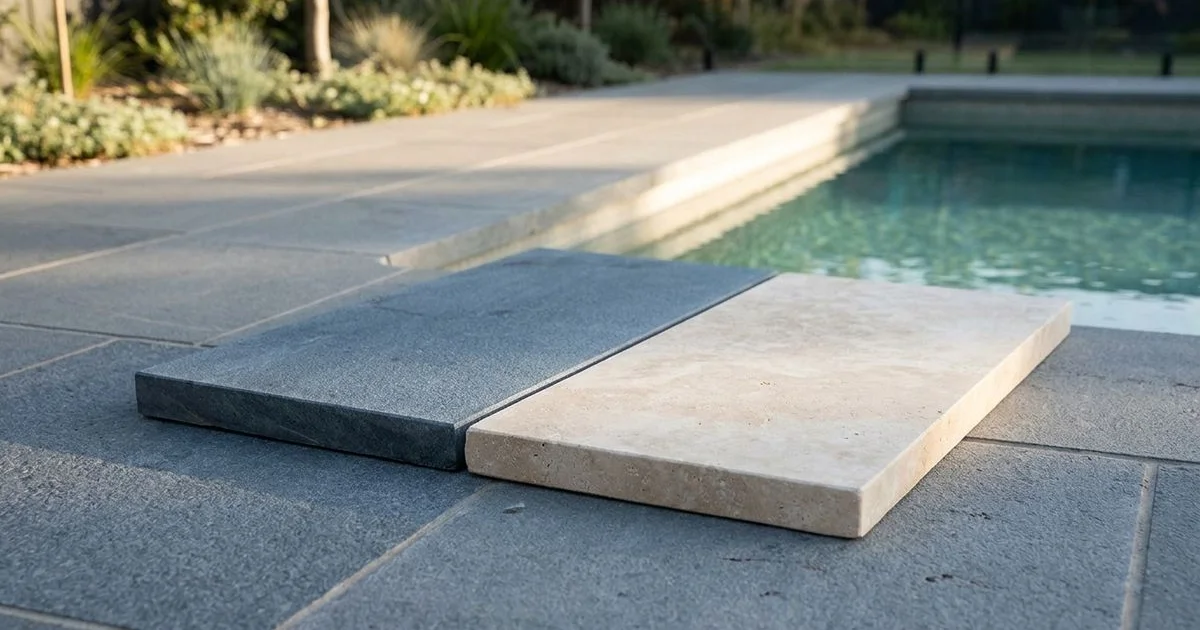
We often see clients torn between aesthetics and practicality when finishing a concrete pool, making the bluestone vs travertine pool coping debate a common one. This decision usually comes down to finding the right balance of heat retention, slip safety, and maintenance.
Our team spends a lot of time helping property owners evaluate these exact trade-offs. The right choice completely transforms how your outdoor space functions during a scorching summer.
Let us look at the hard data and explore how each stone performs in the real world.
The Choice in One Sentence: Bluestone vs Travertine Pool Coping
We can sum up this comparison fairly simply. Honed bluestone is denser, highly durable, and ages into a deeper grey-blue character.
Travertine is paler, softer underfoot, runs cooler in summer, and reads more Mediterranean.
Both are premium choices that work well for Melbourne properties. Your final pick will depend on your architectural pairing and your appetite for ongoing maintenance.
Durability and Longevity
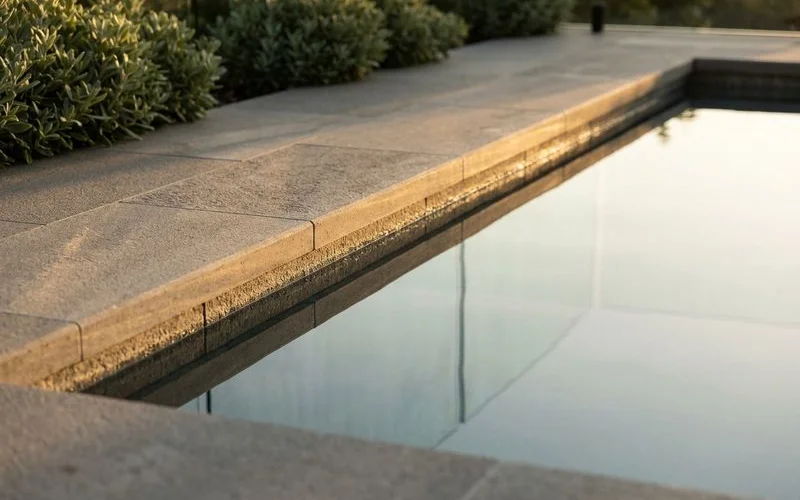
Our team sources high-grade Australian basalt for local bluestone projects. This incredibly dense material shows almost no wear over decades of residential pool-edge service. You will find that local supplies from Kyneton, Port Fairy, or Trentham offer consistent quality with traceable provenance.
We highly recommend specifying premium options like Harkaway Bluestone for challenging terrain in suburbs like Eltham and Kew.
Key durability differences include:
- Bluestone strength: Highly resistant to salt-chlorination wear.
- Travertine porosity: Can develop minor surface pitting over time.
- Freeze-thaw performance: Both handle local mild winters perfectly well.
Travertine is a sedimentary limestone that generally comes from Italy or Turkey. It is softer than basalt and shows surface wear over a few decades. Most residential homeowners will find this distinction academic because travertine will easily outlast the pool shell itself.
Our commercial projects demand maximum durability, making basalt the clear winner for high-traffic zones.
Slip Rating
Our focus on safety always points back to the Australian Standard AS 4586. This regulation requires pool surrounds to meet a minimum P4 slip resistance rating.
Honed bluestone easily meets this standard with an R11 equivalent rating.
Honed-and-filled travertine also falls right into that acceptable R10 to R11 safety zone. We see many Ivanhoe and Kew clients wanting an even higher safety margin for the immediate splash zone. The first 600mm of coping takes the most water traffic.
To maximize grip, consider these textured alternatives:
- Flame-finished bluestone: Offers an aggressive R12 grip profile.
- Sandblasted bluestone: Provides excellent traction while remaining comfortable.
- Tumbled travertine: Uses a naturally irregular surface to prevent slipping.
- Brushed travertine: Features a slightly raised texture ideal for wet areas.
Our landscape designers often transition to these materials for extra peace of mind. These textured options provide superior traction for wet feet.
See slip-resistant pool surround materials for the broader rating context.
Summer Heat Retention
We know how intense a Melbourne February can get. Bluestone in direct afternoon sun actively absorbs and retains solar radiation. Honed bluestone coping at midday can actually reach surface temperatures that are physically uncomfortable for bare feet.
Our primary mitigation strategies for darker stones include:
- Installing architectural pergolas over the immediate splash zone.
- Planting mature tree canopies to filter afternoon sunlight.
- Orienting permanent shade structures to cover high traffic areas.
Travertine reads significantly cooler because its lighter color and porous nature reflect more solar heat.
We consider this the undisputed deciding factor for projects sitting in full summer sun without significant shade. The temperature difference on a 35-degree day is immediately noticeable.
Maintenance and Sealing
Our maintenance crews see directly how different stones age over a five-year cycle. Sealing your pool edge is a recurring necessity for lighter porous stones. You can expect professional sealing to cost between $10 and $35 per square metre depending on the product used.
We strongly suggest using a premium breathable penetrating sealer to protect against organic staining from fallen leaves. Bluestone allows for a more relaxed approach, while travertine requires strict adherence to a schedule.
| Aspect | Bluestone | Travertine |
|---|---|---|
| Sealing required | Optional (recommended for stain resistance) | Yes, every 3 to 7 years |
| Cleaning | Pressure wash, mild detergent | Same plus periodic re-sealing |
| Stain resistance | High once sealed | Moderate; pinholes can collect debris |
| Repair | Stone-by-stone replacement straightforward | Same |
| Long-term care | Essentially passive | Active sealing schedule |
Our clients who prefer a set-and-forget landscape usually find that basalt has the clear lower-maintenance edge.
Architectural Pairing
We find that bluestone reads incredibly naturally with most Australian residential architecture. Its grey-blue color pairs beautifully with local building styles, and the dark tones anchor the space without fighting the existing house structure.
The most successful architectural pairings for bluestone include:
- Heritage brickwork properties in leafy suburbs.
- Mid-century timber homes with natural finishes.
- Contemporary dark-mode builds featuring black steel.
Our design team loves pairing travertine with Mediterranean aesthetics and contemporary white render.
Its warm cream-to-honey color brings life to spaces dominated by pale grey or off-white palettes. We generally avoid using travertine alongside heavy hardwood home styles. Finding the right visual balance is critical for long-term satisfaction.
Cost
Our project managers currently see both materials sitting at very similar price points for premium residential pool coping. The supply and installation of premium bullnose or drop-face tiles typically runs between $130 and $220 per lineal metre in the local market.
Material cost is comparable, and the installation labour required is practically identical.
Several variables influence your final quote:
- Stone provenance and quality grading.
- Custom edge detailing like full bullnose or rebated drop-face.
- Site access challenges common on sloping blocks.
We rarely see the total cost difference act as the deciding factor for a project. Variations usually stay well under 10 percent depending on these specific choices.
For the broader pool landscape context, see our pool landscaping service. For the planting palette, see salt-tolerant plants for poolside gardens.
We understand that choosing the best pool coping Melbourne has to offer requires balancing looks with daily practicality. This pool coping comparison shows that both stones deliver excellent results when installed correctly.
Contact our team today to discuss which material will perfectly suit your property.